
Why isn't the N.C. House Freedom Caucus a bigger deal?
The 33-member bloc has made and broken bills, but still feels more like a rumor than a power center
Statehouse “Freedom Caucuses” are having something of a moment.
In Wyoming, a slate just captured control of the state’s lower chamber and installed its own leadership team and agenda. Nationally, the State Freedom Caucus Network is adding chapters, hosting summits, and putting out glossy videos about successes in Arizona, Louisiana, Pennsylvania, and across the country.
If you click over to their website, you can see all those states proudly shaded on a map. North Carolina isn’t one of them.
But we do have a House Freedom Caucus. It just operates very differently — and mostly out of view.
I’ve known for years that this caucus existed, but not much more than that. So I perked up when chairman Rep. Keith Kidwell gave a rare peek behind the scenes on WUNC’s politics podcast back in October.
“We have made and broke many a bill,” he told host Colin Campbell.
Kidwell says the caucus now has 33 members — almost half of all House Republicans. The officers are Kidwell as chairman, Rep. Ben Moss as vice chair, and Rep. Bill Ward as secretary. Beyond that, the roster stays under wraps.
“Overall membership is kind of kept in the pocket just to play it safe so we don’t have any retribution,” Kidwell said.
You can see what he’s worried about. With filing now open, Kidwell has already picked up a legitimate primary challenger: Belhaven farmer Darren Armstrong.
Armstrong sits on the Beaufort County Community College board — an appointment that came from the Senate, which has clashed with Kidwell over ag bills and that failed shrimp-trawling ban.
Moss and Ward don’t have primary challengers yet, but the message is pretty clear: there’s a fight inside the family.
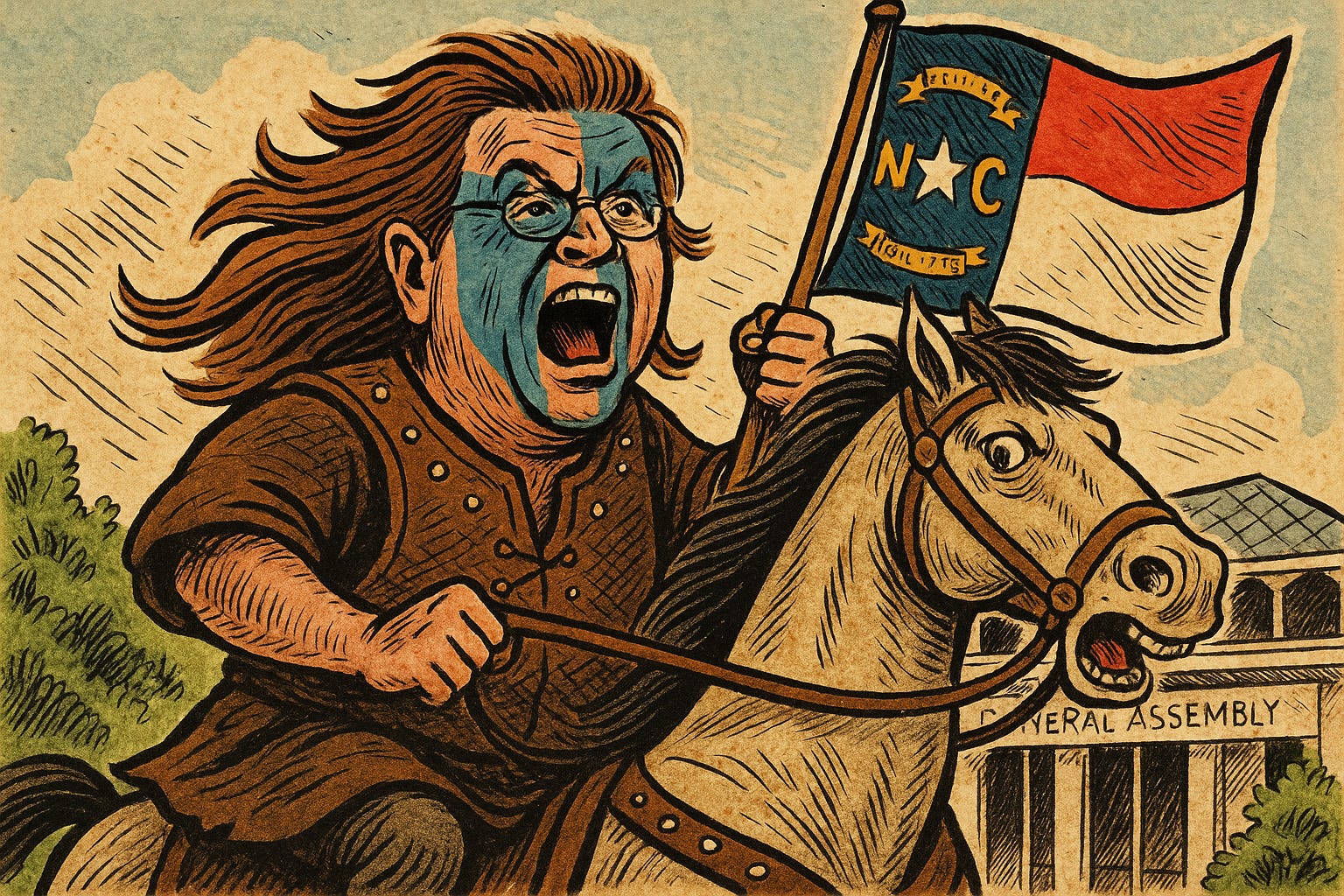
Even so, for a group that large, it’s an unusual level of secrecy.
You can see their fingerprints this year. House conservatives helped defeat a Senate-backed plan that would have effectively banned shrimp trawling on the coast. They pushed a constitutional-carry bill all the way to the governor’s desk. And Kidwell’s NC REACH Act — requiring UNC and community college students to actually study our founding documents — was one of my favorite bills of the session.
Even with those wins, the caucus’ success has been limited.
When former Speaker Tim Moore stepped aside for a congressional run, Kidwell put his name in for speaker. He didn’t have the votes. The job ultimately went to Destin Hall. On the biggest fights in Raleigh, the Freedom Caucus is still more of a factor than a force.
To me, that’s where this gets interesting.
For most of the 20th century, Democrats dominated North Carolina because their party contained real factions. Liberals, conservatives and moderates all fought it out inside one big tent. Republicans now have the chance to be that kind of party — the default governing party for a generation.
That only works if there’s room for different factions and more than one center of power. For the last decade, most of the real authority in Raleigh has been concentrated in Phil Berger’s hands. Whatever you think of his record, that’s not a long-term model.
The House Freedom Caucus is one of the counterweights that has emerged. It’s a sign that House conservatives are organizing themselves, not just taking directions from the corner offices. I’m generally inclined to support that.
And in this filing season, I actually think it’s good for Republican voters to see multiple types of Republicans on the ballot: leadership-aligned incumbents, Freedom Caucus conservatives, and candidates who fall somewhere in between. That’s what a real majority party looks like.
But if a 33-member caucus wants to be more than an interesting rumor, it probably needs more infrastructure: money, candidate support, and a clearer public case for what it’s doing. Otherwise it risks being a big caucus that feels smaller than it really is.
I’ll be honest: There’s still a lot I don’t know about how this thing actually works.
If you’re in or around the N.C. House Freedom Caucus — a member, an ally, or even someone trying to manage around it — I’d love to hear from you. How do you decide which fights to pick? What does “success” look like from your side of the table? What do you want this caucus to be five or 10 years from now?
Reply to this email or reach out privately. Background is fine.
At a premium

Quick hits
I spent Wednesday watching Rep. Brenden Jones grill Chapel Hill-Carrboro school leaders, and I thought he did a great job leading a tough but necessary hearing. In the newspaper, though, I looked past the viral “Santa’s Husband” book toss to what the day really exposed: a growing trust gap between parents, lawmakers and public schools. Even Republicans who want to raise teacher pay are finding it harder to defend the system.
Read it here (free with gift link): Heated hearing shows why NC public schools are losing students — and allies
In less explosive news, House Speaker Destin Hall just opened the most important tax fight in North Carolina that nobody’s talking about: property taxes on the homes we actually live in. My other column last week looked at the coming showdown between Raleigh and the cities — and why real reform should start with treating the American Dream of homeownership with the respect it deserves.
Read it here (also free with this gift link): North Carolina is finally rethinking property taxes
Top spenders on social media last week
Question of the week
Last week, I asked you how you felt North Carolina public schools are teaching students to feel about America. A plurality (30%) of you said “ashamed.”
Thank you for the gift links, Andrew.