
The field of education is notoriously susceptible to fads. North Carolina has lived through plenty of them, often with real consequences for our children.
The most obvious recent example is in how schools teach reading. For years, education experts preached a “whole language” approach, which encouraged children to guess words from context and pictures instead of being systematically taught how letters and sounds work together.
Unsurprisingly, too many students failed to become strong readers. And eventually, public pressure reached a boiling point, forcing lawmakers to step in and require science-backed reading instruction.
But even that may not hold a candle to the fad currently dominating North Carolina public education, with little sign that the people in charge are ready to slow down.
I’m talking about, of course, the digital device craze in schools.
For more than a decade, North Carolina’s education establishment has pushed schools to issue every K-12 student a laptop or iPad, spending more than $3 billion in the process. At this point, the public school system has more than 1.2 million such devices, with 75% of them traveling home with students each day.
The experts called it innovation, equity and personalized learning. But the real impact has been turning the school day into a nearly endless parade of screen time that is crippling students’ ability to learn.
We bought every child a distraction machine, then made it inescapable in the classroom. And we left parents with no meaningful way to say no.

How we got here
You will often hear school districts talk about 1:1 device policies as if they were a COVID-era necessity that never quite went away. That’s not really true.
North Carolina’s device push was already well underway long before schools closed in 2020.
The Mooresville Graded School District was an early adopter, beginning its “Digital Conversion” program in 2007 and distributing laptops in 2008 to students in grades 2-12.
Chatham County was early too, discussing a plan in 2010 to give every student from kindergarten through high school some sort of digital device. The school board voted that year to give high school students new laptops while students in kindergarten through eighth grade got iPads. A spokeswoman said the board was “in full support of the 1:1 program” and wanted to move to a “digital learning environment as soon as possible.”
But the craze really exploded in the early 2010s through then-President Barack Obama’s Race to the Top program, which pressured states to adopt the Common Core standards. Obama visited a Mooresville school to celebrate1.
To win crucial federal funding, states had to agree to implement new standardized assessments that were designed to be taken online, setting off a mad scramble for schools to buy hardware.
Google capitalized on this panic by hosting targeted seminars for school administrators, hyping Chromebooks as revolutionary tools that would “democratize education” and “transform passive consumers into active creators.”
North Carolina jumped right on the train. After a Google education seminar in Union County, local school leaders sounded fully converted. Then-board chairman Richard Yercheck said schools should start asking what “22nd Century classrooms” would look like, because “if you’re not getting ahead of it, you’re behind it.” The district then bought 24,000 new Chromebooks for students in grades 6-12 and pushed thousands of older laptops into elementary schools.
The General Assembly bought in to it, too. In 2013, the Republican-led legislature passed a cluster of laws that pushed North Carolina schools toward screens. These laws directed the State Board of Education to write digital learning standards for teachers and students and declared that North Carolina should start moving away from printed textbooks and toward digital materials. It also created a grant program to help districts re-orient their instruction around technology.
The result was the N.C. Digital Learning Plan, released in 2015. It imagined technology as a constant presence in school: digital textbooks, online testing and assignments, personalized learning software, etc.
In 2016, the General Assembly doubled down on the vision, requiring the State Board of Education to collaborate with the Friday Institute to implement the plan and setting aside millions of dollars to assist with that. The Golden LEAF Foundation also pumped money into 1:1 device programs across the state.
School districts responded in a big way.
Moore County handed out iPads to all 410 students at Carthage Elementary School in 2013 as the first phase of an initiative to eventually provide a device for every student in the school system.
News coverage from that time almost glows with enthusiasm. “The kids are ready for it,” one principal said. A teacher said that if the same lesson had been pencil and paper, some students “might not be as into it,” adding that “the engagement is going to lead to more learning for sure.”
In Graham County in 2016, Robbinsville High School gave every student a new laptop. The principal called it “the most exciting thing that’s happened education-wise” since he had become principal.
News coverage at the time said it did not take much to sell district leaders on the “one device for every student” concept, with the principal saying that technology staff came back from a conference in Raleigh reporting that if the district did not act, “we would be way behind everybody else.”
By 2017, Watauga County had integrated more than 2,500 student Chromebooks into classrooms, increasing digital access down to fourth grade. That same year, Cherryville High School became Gaston County’s first neighborhood public high school to provide a Google Chromebook to every student and teacher.
Carteret County completed a one-to-one Chromebook initiative in 2018 for students in grades 2-12, while kindergarten and first-grade students had access to iPads.
Charlotte-Mecklenburg Schools began rolling out its one-to-one device program in 2018. Cumberland County completed its 1:1 rollout that same year. Pitt County wasn’t far behind.
There were differences in speed and sequence among N.C. school districts, but the direction was clear. North Carolina’s public schools were being rebuilt around screens.
What it looks like today
In 2015, Wake County debated a policy requiring parental consent before students used technology in school. Today, that world is long gone.
Walk into a school now and ask whether your child can opt out of school-issued devices, online assignments or routine screen-based instruction, and the blunt answer is no. Ask me how I know.
It’s not because teaching is impossible without a Chromebook, but because the system has been rebuilt around them.
In nearly all grades, the device is now the place where students complete reading passages, math practice, benchmark assessments and independent work. It becomes the quiet activity when a teacher needs to work with another group. It becomes the make-up station, the review station and the test-prep station.
And it all starts earlier than many parents realize.
In elementary school, the devices often enter through reading and math blocks. A teacher works with a small group while other students rotate through stations. One group reads, while another group puts on headphones and logs into a program like iReady, DreamBox or Amplify. If a child finishes early, the default instruction is often some version of, get on your Chromebook and work.
By middle school, assignments are all posted online. Teachers communicate through Canvas, Google Classroom or another learning-management system. Students read digital articles, complete online quizzes, take benchmark tests, draft writing assignments in Google Docs, watch instructional videos and submit work through portals. Textbooks, when they exist at all, are generally digital.
By high school, the Chromebook has become nearly inseparable from the school day.
Students use it for notes, research, essays, class readings, online textbooks, quizzes, discussion boards, test prep, homework and submissions. Even when a teacher is lecturing or leading discussion, the laptop is open nearby.
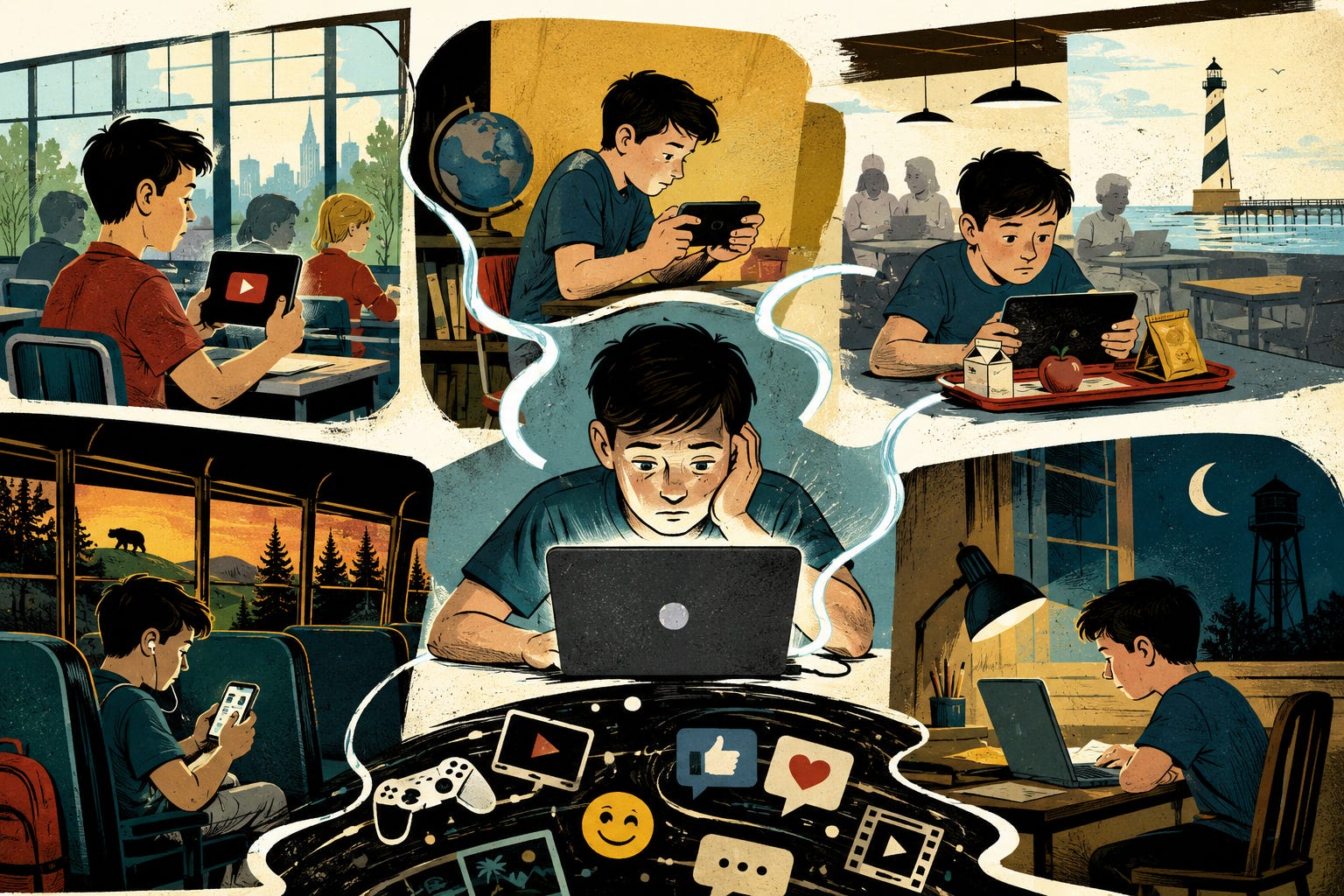
Once school happens on the device, distraction becomes part of the school, too. Students learn which sites are blocked, which ones are not, which games still work, which browser tricks get around filters and which videos can be watched without drawing too much attention.
A break in class becomes a chance to watch YouTube. A few minutes after finishing an assignment becomes game time. Lunch becomes screen time. Homework becomes a reason to open the laptop again, with every distraction one click away.
The impact
During the pandemic lockdowns, school districts used the flood of federal money to buy new devices by the tens of thousands. They are now reaching the end of their useful lives, and so administrators now face the cost of replacing them — and are finding the price tag too steep.
Wake County, the state’s largest school district, is now openly questioning whether the model is financially sustainable. Superintendent Robert Taylor told a school board committee that “one-to-one is something that a district of our size just cannot afford,” and suggested the district move toward “appropriate access” instead.
That’s a problem, sure, but the money is not the main issue. The real problem is that North Carolina spent billions and does not have much to show for it educationally.
If the 1:1 era was supposed to transform learning, it is hard to see it in the results. North Carolina’s NAEP reading results certainly do not look like a vindication of the model. In 2024, only 30% of North Carolina fourth-graders scored at or above proficient in reading, down from 39% in 2017.
Obviously, many things affect achievement, but after billions of dollars and more than a decade of disruption, the device push cannot credibly claim to have put a dent in the problems it was supposed to address.
There is also good reason to think it created new problems.
A growing body of research suggests that students tend to understand and retain material better when they read on paper rather than on a screen. Handwriting appears to support learning and memory in ways typing does not fully replace. Multitasking harms comprehension, and digital devices invite precisely the kind of multitasking, skimming and distraction that serious learning is supposed to overcome.
That tracks with what parents and teachers see. North Carolina just passed a cellphone law because phones distract students, but the school-issued device may now be an even bigger problem inside the classroom.
Dr. Kaitlyn Burnell, director of research at UNC-Chapel Hill’s Winston Center on Technology and Brain Development, told lawmakers that “more students are reporting being distracted by other students’ school-issued devices than other students’ phone use or personal device use.”
Parents push back
Parents are now beginning to push back, and what’s fascinating is that it seems to be a true bipartisan issue. The concern is not especially ideological. Parents are looking at the school day their children actually experience and asking a basic question: Why is so much of this happening on a screen?
A group of Charlotte-Mecklenburg Schools parents launched a petition asking for “balanced, intentional technology use,” including limits on nonessential screen time, more transparency around ed-tech platforms, stronger privacy protections, meaningful consent and clear opt-out pathways for families who want less technology.
In Chapel Hill-Carrboro, Mary Beth Roche launched Parents for Intentional Tech after hearing similar concerns from other families. The group began with 35 people in a focus group and has grown to more than 300 members.
Roche described the values disconnect well. Parents work hard to set screen boundaries at home. Then their children go to school, and those boundaries disappear into a system the parents do not control.
School boards are still (mostly) pushing ahead
Despite all that, most school districts are still not ready to turn around. Charlotte-Mecklenburg Schools now wants $6 million from the county in its new budget proposal to refresh student devices. The district has budgeted roughly $16 million to $20 million in county funding over four years for student device updates beginning in 2024.
The Rowan-Salisbury district recently discussed its 1:1 device program before ultimately reaffirming support for it.
However, there are pockets of change. Burke County, for example, is now going in the other direction. Last year, its school board adopted a resolution encouraging reduced screen use and more balanced instruction. Chairwoman Tiana Beachler called it the first resolution of its kind in North Carolina.
“We’re not anti-technology,” Beachler said, according to The Paper. “We’ve heard concerns from parents and educators regarding the negative effects of excessive screen time. Keeping our kids’ mental health and physical health in mind, I think it’s worthy that we start moving back toward paper and pencil instruction where we can and where appropriate.”
The public response was telling. One teacher thanked the board and wrote that students need to “slow down and work out their problems and pay attention to the process, as opposed to hurry and click an answer.” A tutor said she had seen firsthand how constant computer use hurts basic skills.
The hardest thing for any institution to do is admit that a major investment became a mistake. That is especially true when the investment was not just financial, but philosophical.
Repent and unwind it
The good news is that there is a way out. It does not require pretending computers have no place in school, nor does it require some grand anti-technology crusade.
It starts with a simpler act of institutional honesty.
Thales Academy already went through this. The school network had leaned into educational technology, saw the tradeoffs up close, and decided to pull back.
Winston Brady, Thales Academy’s director of curriculum, explained the logic on the N.C. Family Policy Council podcast. A computer can be “a really good tool if you’re 25,” he said, especially if you have already developed the discipline to use it well.
But adults struggle to put down phones, avoid social media and stop checking email. Now multiply that problem across 20 or 30 students in a classroom.
If teachers spend too much time making sure the tool is being used well, Brady asked, “what’s the point of the tool?”
Then he used the word I keep coming back to.
“In the best sense of the word, we repented,” Brady said. “Once you recognize that you’re doing something wrong, you acknowledge it, you own it and you just stop doing it.”
Repentance is not just regret, but a change in direction. And that is what North Carolina needs.
North Carolina’s 1:1 device push will likely be remembered as one of the biggest education mistakes of the last generation. The state and its school districts made screens too central to the school day, especially for younger children. They made it harder for parents to set limits, harder for teachers to hold attention and easier for students to drift toward distraction.
So start unwinding it.
That does not mean banning computers from school. It means putting them back in their proper place.
Bring back computer labs, textbooks, paper assignments, handwriting and teacher-led instruction. End 1:1 device policies, and sharply limit device use. Use technology where it clearly improves instruction — not as the operating system for the entire school day.
North Carolina spent more than $3 billion making screens unavoidable, then left parents and teachers to manage the consequences.
The way back is not complicated.
Admit it went too far. Own the consequences. Change direction.
Side note: I was there covering it for the Observer. I’ll never forget seeing Marine One land on the school’s soccer field and the swarm of Secret Service guys jumping out of the chopper.
Andrew- excellent article. Way back in 2012 and 2013 when I was a Lee County Commissioner, our then-Superintendent Jeff Moss reprogrammed millions of tax dollars into a large Chromebook purchase, misrepresenting his operational budget to the County Commissioners. As part of the caper, he cut a deal with the DPI to trade off teacher assistants (TA's) in Grades 2-3 to receive permission for moving their salary money around for the technology buy. He created a 1:1 laptop initiative out of thin air, all in the name of technology. Because he misrepresented his operational budget to commissioners, the schools were flat lined (no budget increases) for the next two years. He lost precious TA's permanently out of our school system- the very people who are instrumental in helping our lagging students to get back on grade level. Moreover, because he could not objectively demonstrate the merits of a 1:1 laptop program, he could not secure money for periodic technology refreshes, so many schools had insufficient Chromebooks for the number of students they had. The Supe aggravated the mistake by canceling the purchase of textbooks, meaning instructional materials were digital and often had to be accessed via the web, which many of the poorer families had no access to. Eventually, the school system quietly abandoned the 1:1 project as a dismal failure. It was a very hard lesson learned for our county. Fortunately, today, the Lee County Schools have a more technology-savvy Supe and School Board (all Republican, by the way), and student achievement and growth is on the rebound. All of this was the result of revisiting more traditional, foundational teaching methods, that compel students to apply core math skills, logic and reasoning in the classroom. Now, the movement is to remove other 'technology distractions' from the classrooms- namely cell phones and personal iPads. Technology has its place, but it should never get in the way of proven educational methods.
Thank you for this piece. As a mother of 3 CMS students and a substitute teacher in CMS - the technology issue you described is real. If a student’s device is not working - it can interrupt a lot of time. (But don’t get me started on 2 hours of ELA a day and an hour and a half of math - the devices are just the filler in those endless times).
I always describe a Kindergarten lesson I did: I read a story book (a real book) about “controlling time on a device”. (Thanks to the 20 minutes of SES), and then said, “Kids, now it’s time to take out your IPads).
This is not the teachers’ faults.