
What comes next for Longleaf Politics in 2026
A note on tightening the mission, building something more influential in North Carolina, and adding video to the mix.
Axios ran a fascinating piece recently about New York Times columnist Ezra Klein. It’s short, so I recommend you just read the whole thing, but the gist is this. With an influential podcast and a new best-selling book, Klein is no longer just opining on politics. He has “positioned himself as a powerbroker” inside the Democratic Party.
That’s made some people at the Times uneasy, unsurprisingly. But it’s really not a new phenomenon. I say this all the time, and it keeps proving itself true: We are not in unusual times, in politics or media. Rather, we’re actually drifting back toward the natural order. The 1950 to 2005 period was the historical exception, with its unique mass media culture and unusually broad social consensus.
For most of American history, politics has relied both on elected leaders and the writers and editors around them that add some intellectual and rhetorical heft. We’re just getting back to that now.
The theory has popped up elsewhere, too. Nate Silver wrote recently about Heather Cox Richardson, a historian who teaches at Boston College and writes one of the most popular newsletters on Substack, “Letters from an American.” Silver turned her name into an ideology, and argues that “Heather Cox Richardsonism” is the Democratic equivalent of the Tea Party.
All of that has me thinking about my own corner of this ecosystem. I’ve been trying to figure out what Longleaf Politics should be for nearly eight years now, experimenting in one direction and another. If I’m honest, I’ve often stayed in the safe lane of analysis and journalistic distance. In 2026, I want to tighten the mission.
I don’t want to just react to North Carolina politics. I want to help shape it.
2025 was a great year
Which brings me to why I’m writing this note at all. Longleaf Politics had a great year in 2025, the best year since the reboot after my work on the Dan Forest campaign came to an end. That’s not something I take for granted, and I don’t want to waste the momentum.
The opportunity is sitting right there. The old gatekeepers are weaker, the conversation is more fragmented, and there’s still plenty of room in North Carolina for a place that tries to think clearly about what’s best for our state.
So that’s the big picture. Here’s what it means for Longleaf Politics in 2026.
The big move last year was introducing paid subscriptions. I turned them on without really knowing what would happen, and I’m humbled and grateful for everyone who’s signed on.
In 2026, I’m going to find ways to make a paid subscription even more valuable. Some of that will be about long-term resources. But trying to just produce more content is a hamster wheel that can burn you out quick. The more important point is this: If you’re a member, you’re part of a team. You’re helping build something that can actually help good people run and govern, and help North Carolina get a little more serious about competence.
The other big new thing in 2026 is video.
I’m planning to start producing medium-length conversations with people worth hearing from in North Carolina politics and policy. If you’re interested in coming on, hit reply. I’m starting to book guests now.
If the financial model works, I’d like to do more produced video too, especially explainers. That means hiring a video editor or producer, which can only happen if subscribers or sponsors want to help make it possible.
I’m also finishing a book. More on that soon.
Next week, I’ll publish my predictions for North Carolina politics in 2026. For now, happy New Year. Thanks for reading. If you’ve got thoughts on what you want more of here, or less of, hit reply. I read every note.
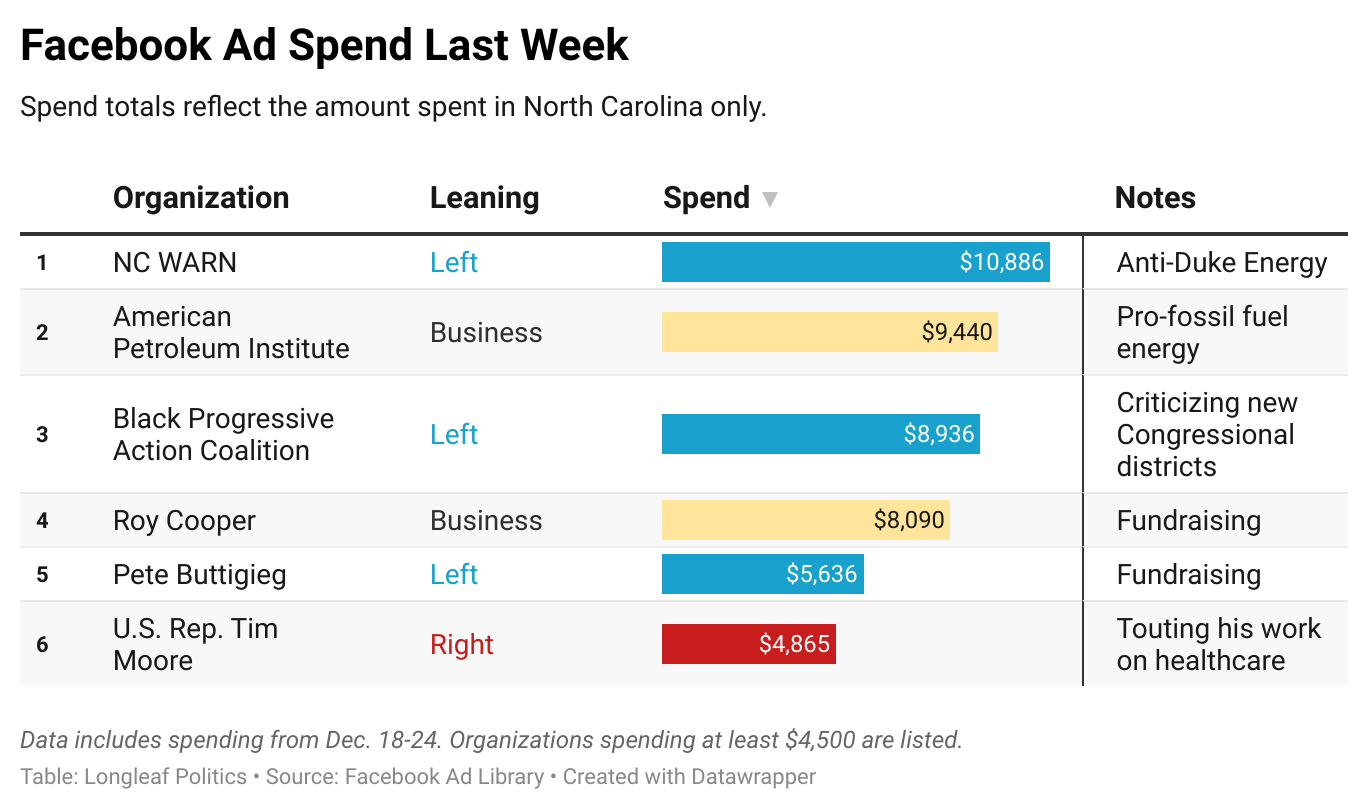
Top spenders on social media last week
I’d love to come on and have a conversation from CabCo to WNC.
So what did you choose, to be a Republican shill in 2026?