
On the evening of June 2, 2021, two armed men forced their way through the front door of a Fayetteville home and started shooting.
When the gunfire subsided, the homeowner was dead, his teenage daughter had been shot in the leg, and both assailants had fled.
One suspect soon died at a Hoke County hospital from a gunshot wound to the chest, police said. The other was later identified by police using Ring doorbell footage as Calvin Wayne Locklear.
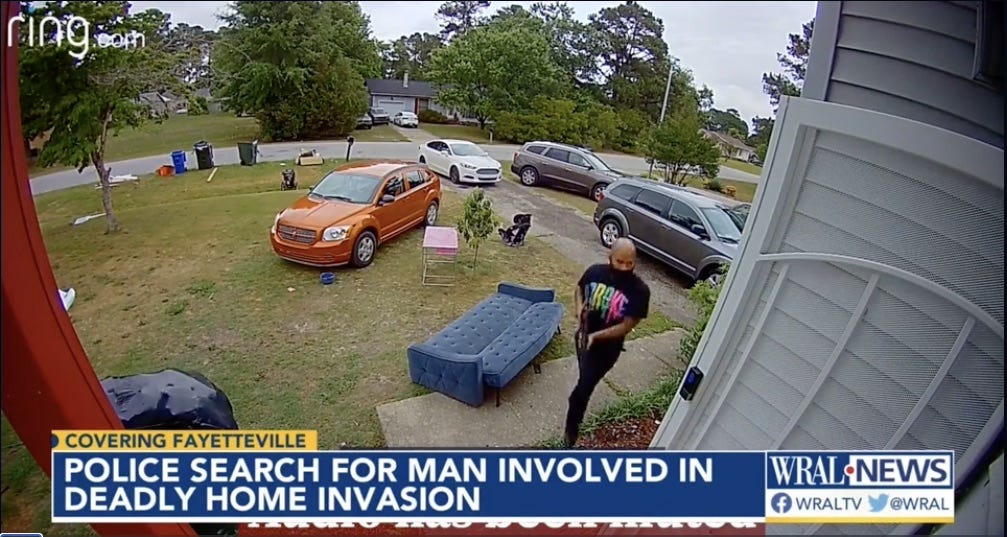
Police charged him with first-degree murder, and Locklear eventually pleaded guilty to second-degree murder and was sentenced to 30 years in prison for the home invasion killing, according to state records.
It was not his first time behind bars. And based on the records I’ve reviewed, it is not clear why he was free that June evening at all.
Locklear was one of more than 4,000 offenders who appeared on the “early release” list prepared to satisfy a 2021 settlement between Gov. Roy Cooper’s administration and left-wing activist groups who sued over prison conditions during COVID.
The New York Post looked at the data and reported that thousands of offenders that Cooper “set free” went on to commit new crimes, including 18 later charged with murder.
But is that the real story? Or just another example of what Carolina Forward calls “Cooper Derangement Syndrome”?
That question sent me down a rabbit hole. The deeper I went, the less convinced I became that the simple version explains what actually happened. The reality is much murkier – and in many ways, much more depressing.
What I found was not one clean smoking gun. It was something more frustrating: a justice system that keeps moving dangerous repeat offenders in and out of the system with little accountability.
That, to me, is the real scandal.
Note: My research for this story began with the new site CooperReleasedHim.com. This is a pretty big achievement from independent journalist Stephen Horn to make the opaque early release list open to the public.
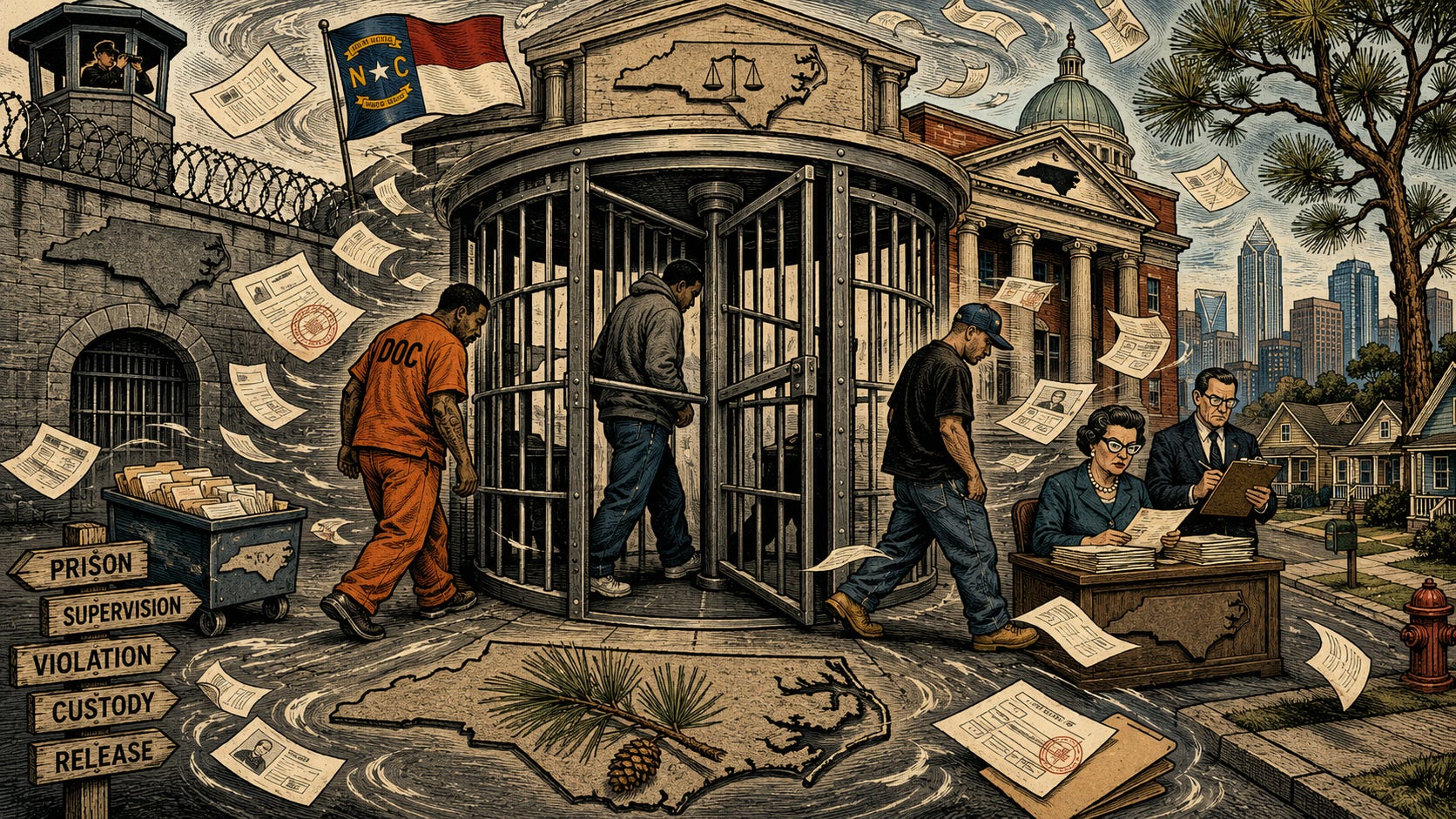
The revolving-door justice system
The simple version of this story is that Cooper opened the prison doors during COVID and thousands of inmates walked free. That is not really what happened.
When you dive into the actual cases, it appears that very few people were actually set free from prison early in the way normal people would understand that phrase. In almost every case I examined, the “early reentry” the settlement afforded simply meant cutting short the parole period, or counting people the system had already moved out of state custody.
That’s not necessarily vindication for Cooper. Because what you see in those files is not mercy or careful rehabilitation. It’s a revolving door. North Carolina already had thousands of repeat offenders moving through the system again and again. In that sense, Cooper’s settlement looks less like a one-time jailbreak and more like business as usual inside a broken system.
What the early release list does is make the problem more concrete. It tracks 4,234 offenders tied to the Cooper settlement, with a staggering 52,000+ offenses on their records before the settlement. Afterward, 2,412 were listed as recidivists, with more than 6,100 post-release offenses.
Those are huge numbers, but nothing out of the ordinary. An official state recidivism report found that prisoners released under the COVID settlement had a 48% recidivist arrest rate within two years, slightly higher than the 44% rate for regular prison releases.
Looking through their files, you see people cycling in and out. They often serve shockingly little time for serious crimes. They get released onto supervision. They violate their parole and go back into prison. They leave again. Then, in case after case, they return to the same conduct that brought them into the system in the first place.
No case I’ve found captures the problem better than Locklear’s.
The Locklear timeline
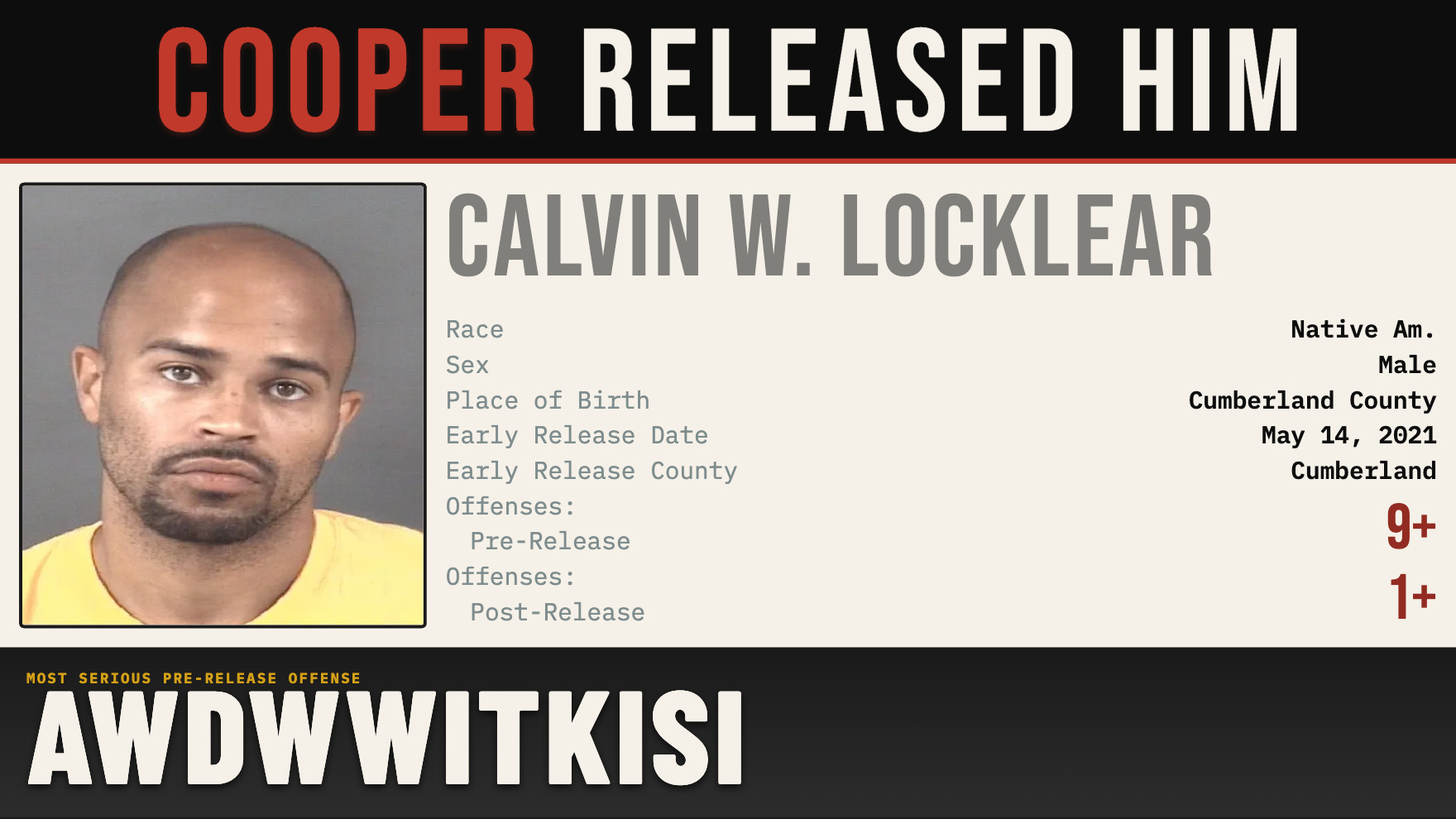
Calvin W. Locklear appears on the early-release list as offender number 1044422, verified by N.C. Department of Adult Correction records.
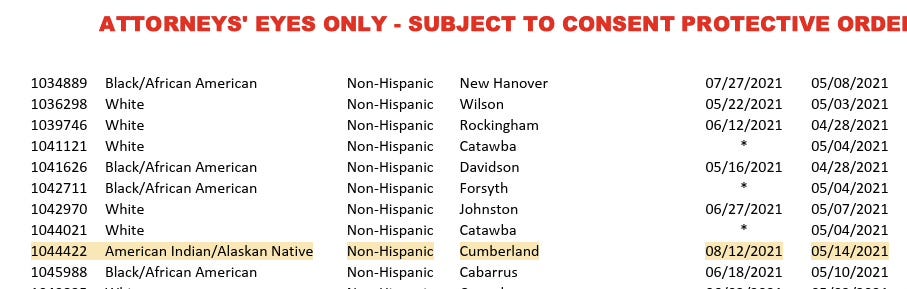
His record goes back to 2008, when Locklear was arrested after police found 20-year-old Rodriguez Harris lying on a Fayetteville road with a gunshot wound to the head. Locklear, then 19, was wanted for attempted first-degree murder and common law robbery in connection with the shooting.
State records show he was convicted in July 2011 of manslaughter, assault with a deadly weapon with intent to kill inflicting serious injury, common law robbery and malicious conduct by a prisoner. He was sentenced to a term between 8 years, 4 months and 10 years, 9 months, state corrections records show.
Locklear was released from state prison onto parole on April 12, 2020, after serving those sentences.
Because the details on all these cases can be so murky, I checked the records with Keith Acree, the communications director for the N.C. Department of Adult Correction. He sent me a timeline of the case from there.
Six months later, while still on parole, Locklear allegedly committed new offenses, the corrections department stated. Warrants were issued in October 2020 for habitual misdemeanor assault, possession of a firearm by a felon, and assault with a deadly weapon inflicting serious injury. He was arrested on those charges on November 18, 2020.
The next day, the Post Release Supervision and Parole Commission issued a warrant for violating his supervision. After a preliminary hearing, Locklear was ordered returned to state custody while the commission reviewed his case.
On December 4, 2020, Locklear was transferred from Cumberland County to state custody. Three days later, the commission revoked his parole and returned him to prison, with a projected release date of August 12, 2021, according to the early-release list.
The Cooper administration’s settlement came two months after Locklear reported to prison, in February 2021.
According to the N.C. Department of Corrections, the state received a detainer notice from Cumberland County, indicating that they wanted to hold him on charges from the October 2020 alleged offenses.
On April 15, 2021, state officials confirmed that the Cumberland County Sheriff’s Office would pick him up when he was released. On May 14, 2021, the state released Locklear to the Cumberland County jail.
Under the Cooper settlement, Acree told me, that transfer counted as “early reentry” since his state confinement was ended. Locklear’s post-release supervision status was reinstated upon transfer, and he exited a state prison facility at least 14 days earlier than his projected release date under the settlement.
Put plainly, Locklear left state prison early under the Cooper settlement and went into county custody because he had pending charges.
What happened next is less clear. Cumberland County apparently released him sometime before June 2, 2021. I asked the Cumberland County Sheriff’s Office for records related to his release, and my requests went ignored.
But the result is clear enough.
Locklear’s projected state release date was in August. He left state prison in May. Less than three weeks later, a 33-year-old father named Justin Jackson was shot dead inside his own home.
Who was responsible?
Leaders in the General Assembly have just created a Governmental Operations subcommittee to investigate the Cooper-era releases, including how decisions were made, what conditions were attached, how parole was managed, and what role current Gov. Josh Stein’s Department of Justice played when Stein was attorney general.
It’s easy to write this off as pure politics. Cooper is running for U.S. Senate with a handy lead.
But I see real lasting value in getting to the bottom of what these cases reveal about the sieve-like nature of North Carolina’s justice system.
To me, the deeper question is simple and unanswered: Who in North Carolina is responsible for keeping bad guys locked up?
At this point, Cooper’s early-release list likely never becomes the clean political scandal some people want it to be. North Carolina should still make good come out of it.
Good reporting. The revolving door problem is particularly acute here in Charlotte, where a self-proclaimed ‘jail abolitionist’ has just effectively been elected to the bench.