
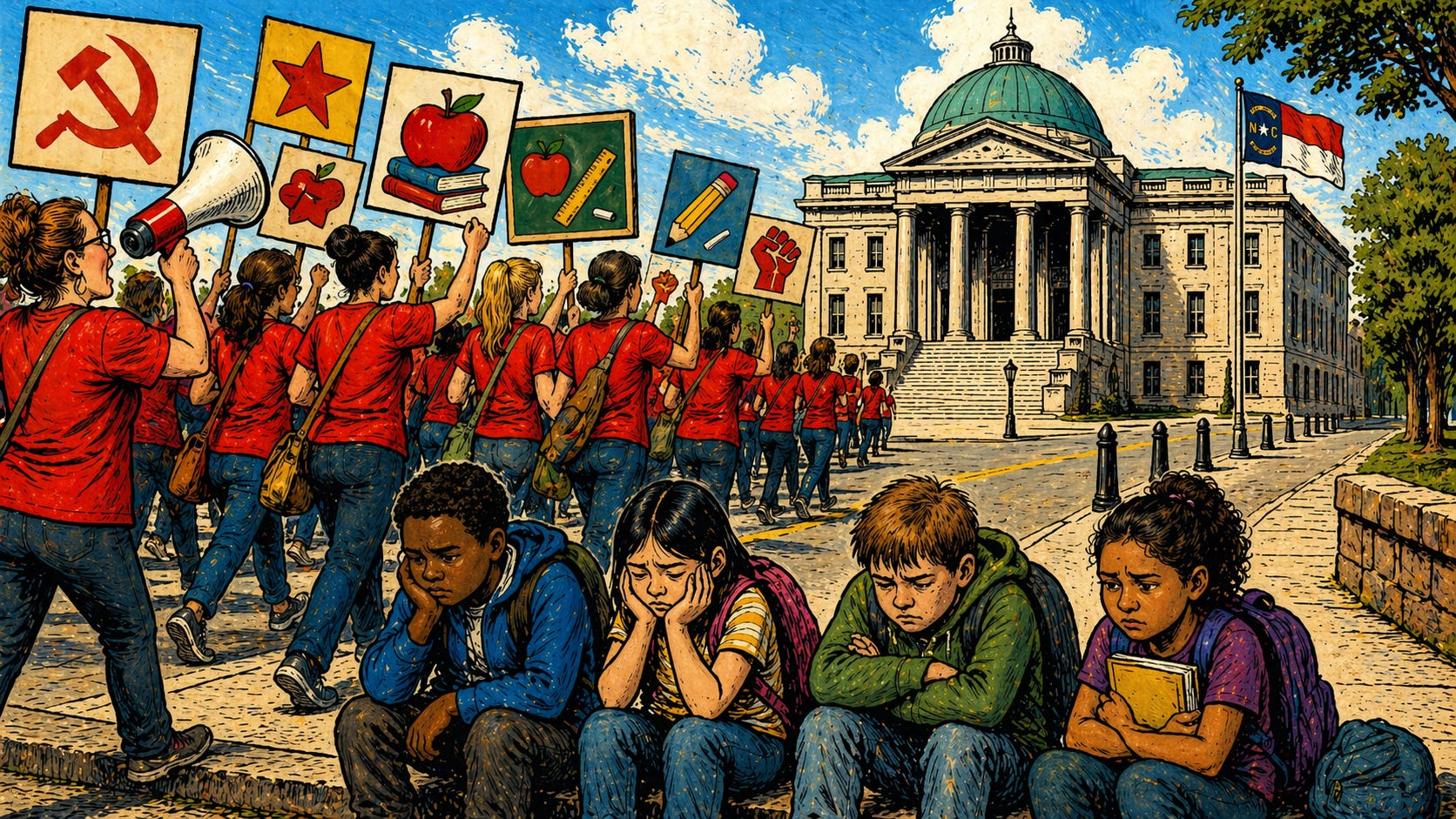
Welp, it’s official. My kids will be out of school on Friday now that Charlotte-Mecklenburg Schools decided to make it a teacher workday to accommodate the May Day protests up in Raleigh.
Chances are you’re in the same boat, since most of North Carolina’s urban districts have done the same thing. My older daughter is about to take EOGs for the first time, and she is already anxious about it. Great time for an extra day off school.
I wrote about the N.C. Association of Educators’ plans in my newspaper column this week. My basic point is that when a “teachers” group measures success by how many classrooms it can empty, it’s a pretty good sign that this is more about political power than educational stewardship.
Read it here, free with gift link: NC teacher walkout is sacrificing students for left-wing politics
But the mess does raise a broader question that is worth thinking about on its own. Where, exactly, is the line between political theater and political mobilization? In other words, when does a protest become a stunt, and vice versa?
Real mobilization is one of the hardest things to achieve in politics. Getting people to care enough to leave work, rearrange their lives, and physically show up somewhere is incredibly difficult, at least for normal people. Most political leaders cannot do it on command, no matter how many emails they send or how many consultants they hire.
I don’t think I’m going out on too much of a limb by saying the organized left is far more comfortable with protests, pressure campaigns, and public demonstrations than the right is. You’ll see some kind of liberal rally every other week. When is the last time conservatives in North Carolina really did anything similar?
Both sides get this wrong in their own way. The left overdoes it. Democrats are often too quick to turn every grievance into a march, every policy fight into a moral emergency, and every institution into a pressure target. Republicans, meanwhile, often act like public mobilization is too corny or messy to be worth trying. That leaves conservatives with electoral power, but not always much organized civic muscle between elections.
That is why I tend to look at protests through a pretty simple framework. Is it bottom-up or top-down? Is the grievance real? Are the demands realistic? Were other methods tried first? And is the pressure aimed at the right target?
Real mobilization usually comes from somewhere deeper than messaging. It has to tap into a frustration people already feel in their bones. When it works, it feels less like an event and more like a release valve.
That is part of why the examples that stick in my mind are things like Widen I-77 and ReOpen NC. Whatever you thought of them, they felt real. They did not feel like consultant products or institutional rituals. A lot of the more local No Kings protests are the same way.
This year’s May Day demonstration does not really clear that bar. It is not a spontaneous uprising. It is a highly organized, top-down action. The demands stretch well beyond practical school concerns into a broader ideological program. And the tactic is not especially well aimed. The legislature will not even be there Friday. Lawmakers will be back home for the weekend. The people feeling the disruption most directly are parents and students.
That is usually a bad sign. A good protest puts pressure on the people who can solve the problem. A bad one mostly burdens bystanders and calls that leverage.
This one has enough organization behind it to be disruptive. I am just not convinced it has enough authenticity or enough discipline to be effective.
That may be the real dividing line. Political theater seeks visibility. Political mobilization builds legitimacy. From a distance, the two can look pretty similar. Up close, they are very different things.
At a premium


Top spenders on social media last week
Question of the week
Last week, I asked you about marijuana. A narrow plurality of you (38%) were OK with medical marijuana, but not full legalization. The next biggest group (33%) didn’t want any marijuana legalization.
After Covid, any illusion I have about the NCTA being effective is gone.
There are so many issues with this day and its perception, I don’t even know where to begin.