
I picked up the late Gov. Jim Hunt’s short little education book for a simple reason: I wanted to understand why he became known as North Carolina’s “education governor.”
Honestly, I expected this short book from 2001 to read like a time capsule or a relic. Instead, I found it to be shockingly current.
Hunt published First in America: An Education Governor Challenges North Carolina the day after he left office, with a challenge for North Carolina to become a top-tier education state by the end of the decade.
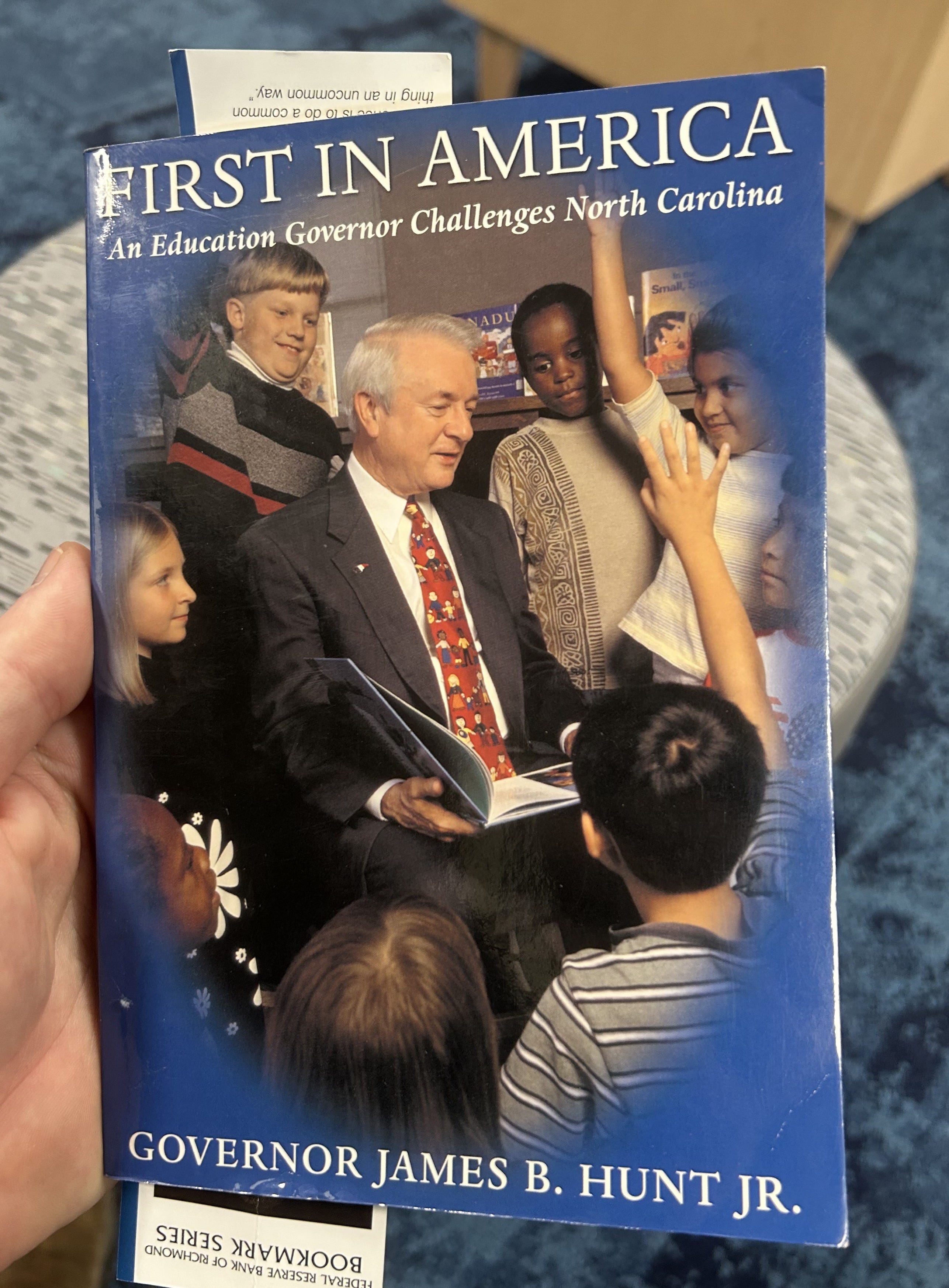
That … did not happen, obviously. But the book remains striking for its mix of ambition and realism. Hunt believed deeply in public schools, and he also saw their flaws pretty clearly.
That in itself is notable. How many political figures today acknowledge that you can support public schools without making excuses for them?
Not every part of the book aged perfectly. Hunt was too optimistic, I think, about what government could do by itself. Schools cannot overcome the breakdown of the family, no matter how many programs you try to create.
But I think the core of his message remains a pretty solid education agenda. It just won’t likely come from a Democrat.
Better early childhood education. Hunt’s solution for this was Smart Start, his signature program and the one he defended tooth and nail until the day he died. I think Hunt was clearly right on the diagnosis, but I’m not sure about the efficacy of the program. There hasn’t been a rigorous study of Smart Start in a decade at this point, and it’s likely due for an update or overhaul. North Carolina implemented universal full-day kindergarten in 1978, and I think universal public pre-K might be a good idea at this point.
More, smaller schools. Hunt thought schools had gotten too big. He admitted that he had supported consolidation earlier in his career, but came to believe the country had gone too far. Schools had become enormous and impersonal in the name of offering more courses and more opportunities. He wrote that no high school should have more than 1,000 students, no middle school more than 600, and no elementary school more than 400. That’s pretty radical today, but I love it. Hunt never really got into charter school debate in the book, but today, this feels like part of the solution here.
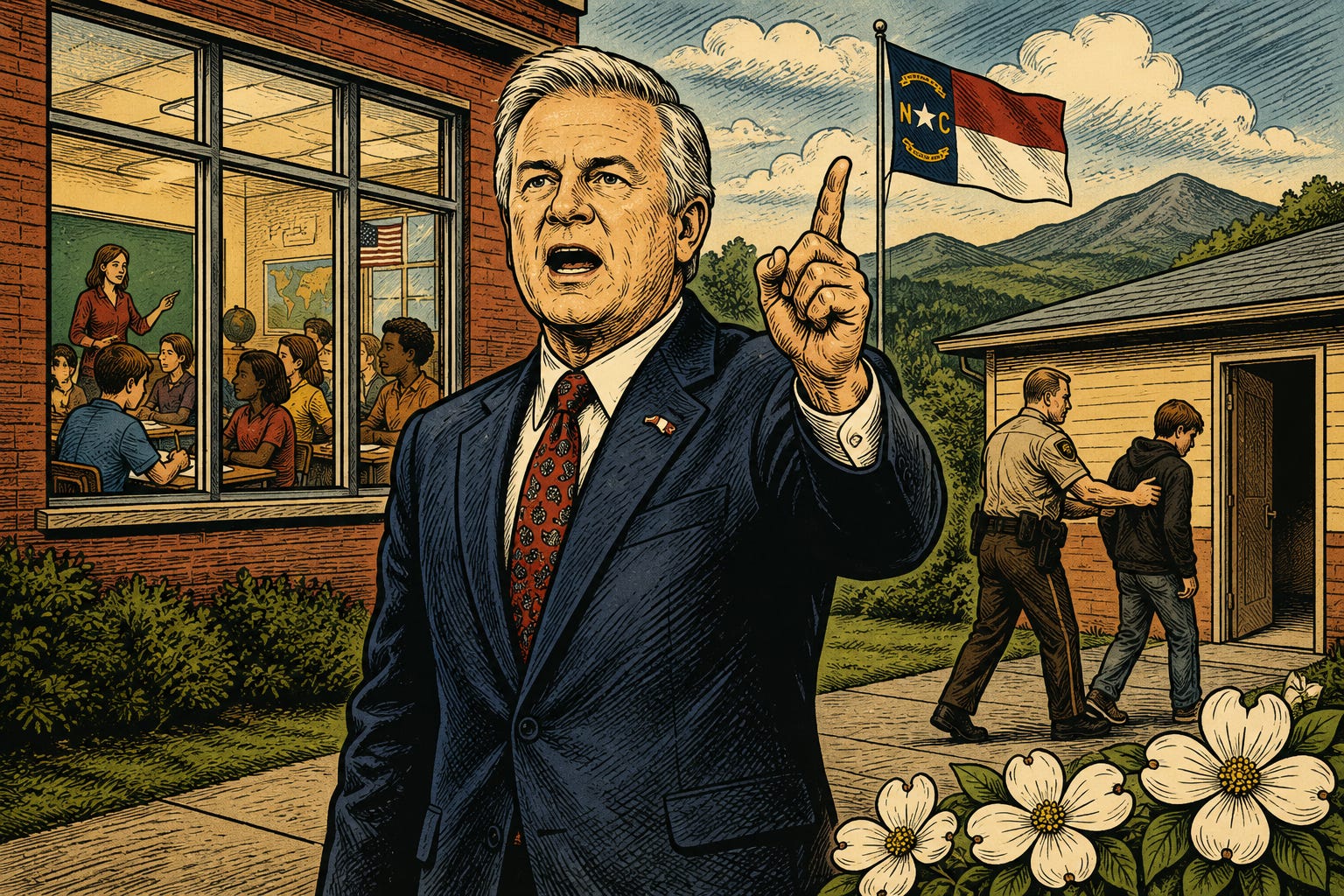
Eliminating disruptions. Hunt was also unusually direct on school safety. He wrote that disruptive and violent students should not be allowed to keep hurting other children or stopping them from learning. His answer was not to abandon those students. It was to put them in alternative schools, separate buildings, or different campuses where they could still be educated without making learning impossible for everyone else. Our education policy has moved in the opposite direction.
Money does not equal quality. At one point in the book, Hunt complains that many educators wanted progress measured by how much money got spent, while resisting efforts to measure the performance of schools, teachers, or students. “It’s also important to insist that our schools set high, real-world standards for what all students should learn, and that teachers teach all students to meet the same standards,” he wrote.
The takeaway
The left often treats criticism of public schools as an attack on teachers, students, or public education itself. A significant part of the right see the failures and leans toward writing off the institution altogether.
Hunt did neither. He supported public schools while being clear-eyed about their role, their flaws, and the interest groups involved. He believed they were important enough to defend and important enough to challenge. He wanted more for schools, but he also wanted more from them.
That is the forgotten part of his education agenda, and that is a harder line to walk than it sounds.
“I believe the educators make it too complicated and the politicians make it too simple,” Hunt wrote. “They are both wrong.”

Sounds almost Republican. Wonder if he would be a Republican today. So much common sense.
Great article. It’s wonderful to see real journalism where writers do the research and read from actual sources!