
I generally try to keep a sunny attitude about politics, but this election cycle has left me feeling beaten down. I haven’t felt this discouraged about one in a while, and it had nothing to do with who’s up or down in the polls.
Maybe I’m just getting older. Maybe it’s the 1,500 emails from Michele Tafoya, who certainly never got my email address from me. Maybe it’s the accumulated effect of a decade of toxic personality politics.
But what I really think it is, is that we’re in a precarious position as a country, and our politics is coming nowhere close to meeting the moment.
Here are four of the five most-shown political ads on YouTube in North Carolina over the last 30 days, shown at least 30 million times.
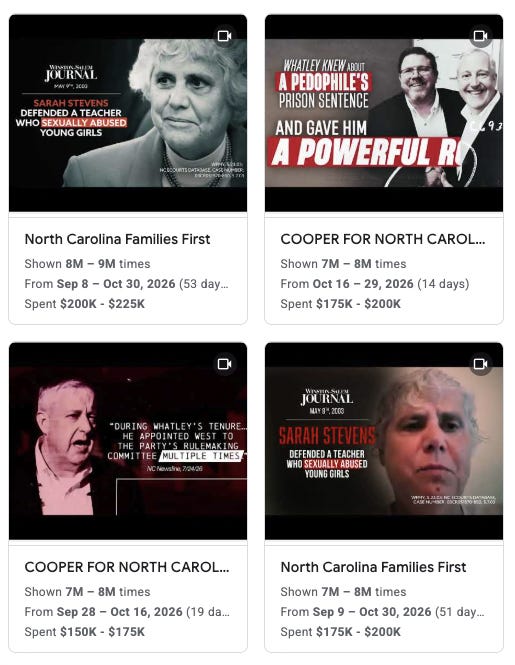
It’s hard to feel good about an election when we’re debating which candidate has the closest ties to sex offenders instead of who has a better plan for the country.
Meanwhile, Kalshi led North Carolina political and issue ad spending in Meta’s Ad Library Report over the past 30 days, asking us to gamble on it all.
I can’t think of a more fitting sponsor.
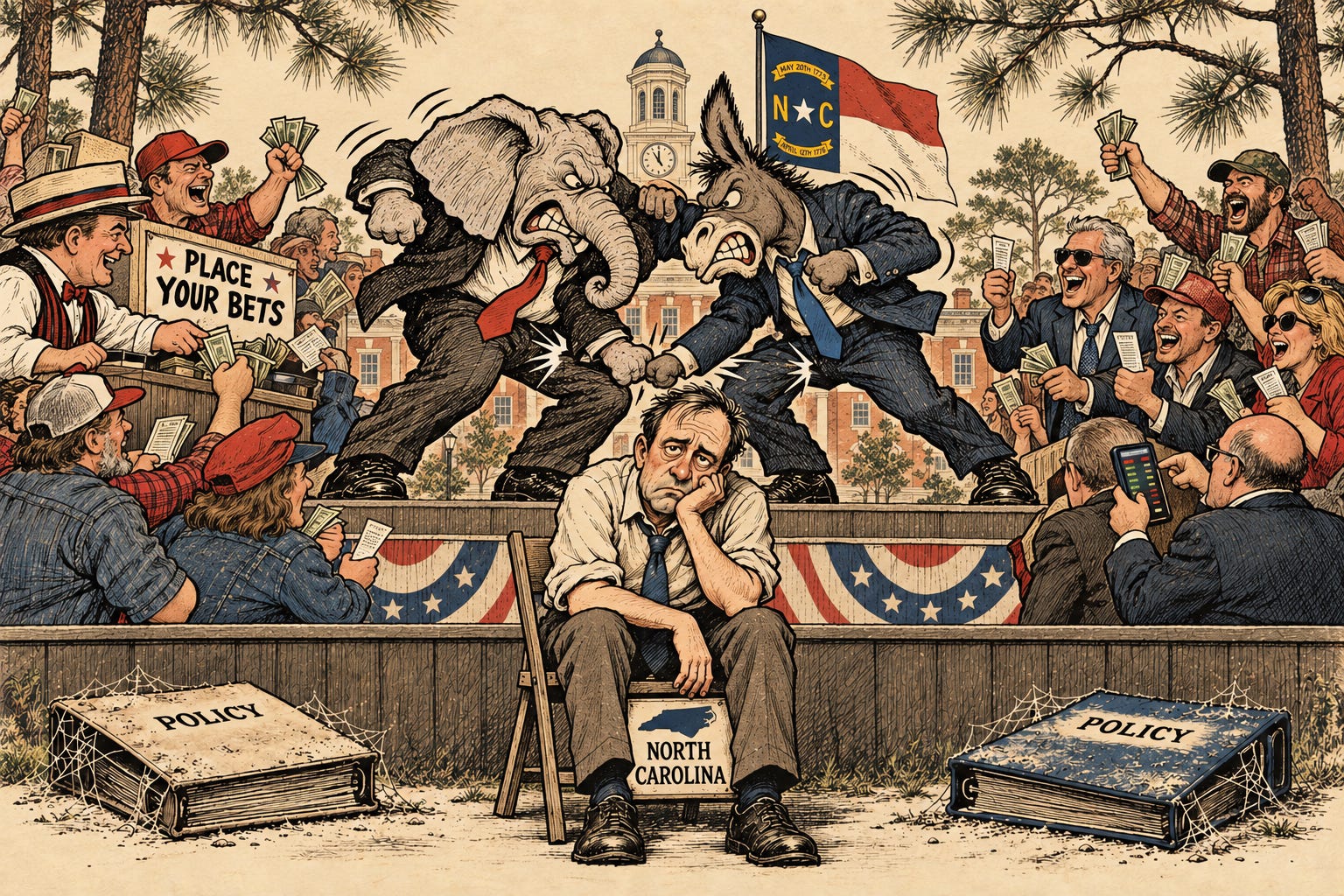
The original vibes election
I’m not nostalgic for some imaginary era when everybody studied the party platforms before voting. The old “vibes and turnout” campaign has always been part of politics.
In 1840, William Henry Harrison ran for president on an image of log cabins and hard cider, promoted through enormous rallies and an abundance of campaign merchandise. Harrison actually came from a privileged Virginia family, lived in a mansion and enjoyed imported wine.
After he won, a newspaper sympathetic to his opponent complained: “We have been sung down, lied down and drunk down.”
But Harrison notwithstanding, candidates at least used to seem more obligated to explain what they wanted to do in office. Maybe some of that was going through the motions. I’d like the motions back.
Voters used to switch sides more often, too. Political scientist Corwin Smidt found that the share of Americans switching between major parties in successive presidential elections roughly halved between 1952–1980 and 2000–2012.
The campaigns know the math. There’s little expectation of winning anybody over, so the plan is just to try to get their own voters angry enough to show up.
Something to argue about
The closest I’ve seen to an energetic policy discussion lately is the populist revolt against data centers and Flock license-plate cameras. At least those arguments involve decisions somebody actually has to make, even if the facts can be hard to come by.
We didn’t get a debate in this year’s U.S. Senate race, but I’ve spent plenty of time over the past year watching old debates between Jim Hunt and Jesse Helms.
They certainly weren’t going easy on each other, but they were arguing about taxes and spending. I’d love to have a campaign centered around federal spending again. Hell, I’d settle for a fight over cigarette taxes.
This is part of why I write this newsletter. I like arguing about what North Carolina ought to do. I’ve changed my mind about things because a reader made a good point, and I hope I’ve occasionally returned the favor.
I’d like to get through an election feeling like I’d learned something besides whom to despise.

Excellent column; I share your feelings. How well I remember Helms and Hunt debating the federal cigarette tax in 1984 as if that issue would decide the election. How far we have fallen.
I agree with your broader sentiment here (both in terms of the deluge of negative advertising and that very little of modern politics seems to be related to real policy), I do wonder how much of this effect is also down to debates vs online advertising. Even the 2024 Presidential debates had a little discussion of policy, while ads need to be memorable in 15 or 30 seconds, incentivizing ultra-simple messages.
I also find it interesting that you use Jesse Helms (and Jim Hunt to be fair) as a contrast. I wasn't around for Helms, but from I have read from him he is remembered for pioneering nationalized direct-mail fundraising (feeding into the highly expensive ad-happy campaigns of today. EDIT: and 1984 is seen as a particularly extreme case of his tactics foreshadowing the endless negative modern political ad campaign) and for his... controversial campaign messaging (Hands, "He's one of us,"). Do you think that he is viewed sometimes be conservatives with rose tinted glasses, or do you think that liberal criticisms of him are largely baseless?