7 predictions for N.C. politics in 2026
It's going to be one heck of a year, even if the biggest event is in March
I’ll admit that my predictions for 2025 didn’t all pan out. But that won’t stop me from offering up my takes on what’s coming next year.
Before we begin, I just wrote a column for the N&O and Charlotte Observer about what I’m watching in 2026. The hinge of the entire year will be the primary race between Sen. Phil Berger and Sheriff Sam Page, with the results trickling down through the N.C. political world. Meanwhile, the U.S. Senate race is likely to be a dud.
Read it here, free with gift link: What to watch in N.C. politics in 2026
So I’m not going to offer a prediction on who will win either of those two races. One is about 50/50, and the other feels right now like it’s already over. I’ll let you guess which one’s which.
But I do have a fresh slate of predictions for what will happen in N.C. politics in 2026. These, I guarantee you, will be 100% accurate, but I’ll open it up to your votes anyway.
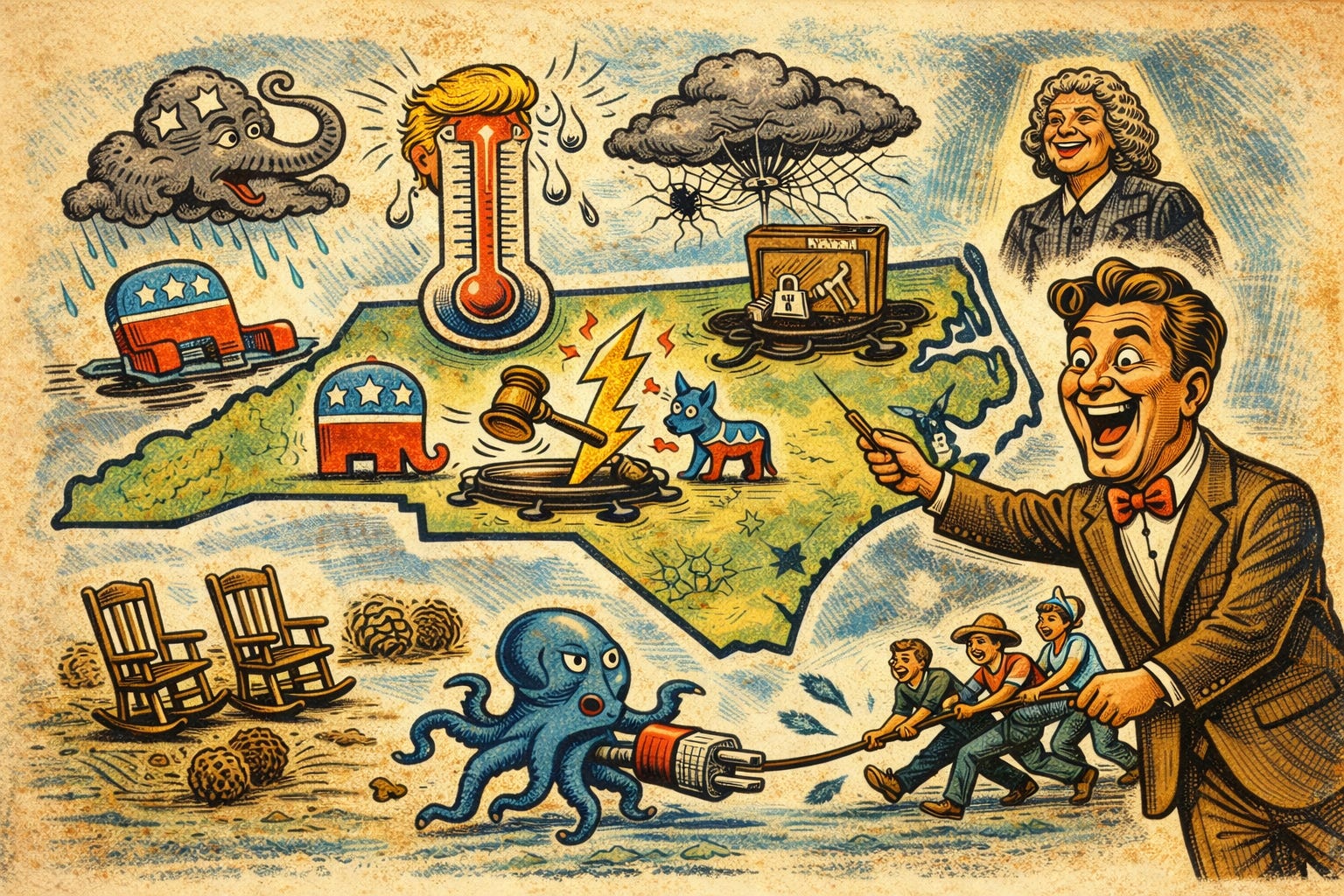
1) Republicans will not pick up a Congressional seat in the 2026 elections
Right now, North Carolina sends 10 Republicans up to the U.S. House in Washington, and four Democrats. If you read this newsletter, you already know that the General Assembly redrew the maps to try to squeeze out one more red seat.
My prediction is that in the 2026 elections, in a “blue wave” year, we’ll stay right where we are.
There are a few ways this could happen. But the two most likely are that either:
Democrat Jamie Ager beats U.S. Rep. Chuck Edwards in the 11th, which has become only an R+4 district.
U.S. Rep. Don Davis holds on to his 1st Congressional District seat.
U.S. Rep. Greg Murphy could also conceivably lose his redrawn 3rd Congressional District seat, but this feels less likely.
2) Trump’s approval rating will fall to a record low in North Carolina
In his second term, President Donald Trump’s approval ratings in North Carolina have been significantly higher than they were at this point in his first. But the numbers are starting to slip, and I predict they’ll reach a record low in 2026.
The chart above includes results from several different polls, making it hard to see a clear through-line. But if you compare the results from the same poll over time, it’s pretty clear that Trump’s approval is slipping in North Carolina.
In 2017, Trump’s approval hit its nadir at 33% late in the year, then began to steadily rise higher through 2018 and to the end of the term. The Brett Kavanaugh confirmation hearings coincided with the rise.
I don’t see a similar rallying point happening in 2026, and I predict Trump’s approval will continue to fall as his coalition fractures.
For this prediction to be right, at some point in the year, there needs to be a poll that shows Trump’s approval in North Carolina at or below 33%.
3) The General Assembly will not pass a comprehensive budget in 2026
This is the hardest prediction to make, because I also see a world in which the General Assembly passes a budget in April. Basically, I see one of two paths.
In path one, Berger loses his primary challenge and his grip on the Senate breaks completely. After being largely invisible in the last half of 2025, Gov. Josh Stein then emerges with a more ambitious agenda.
Stepping into the power vacuum left by Berger, Stein collaborates with the state House to get the House version of the budget (or something very close to it) signed into law. Enough Republican senators defect from the Berger machine after the primary to get the budget through that chamber.
Then there’s path two. This one could actually hold whether Berger wins or loses his primary race. But it involves both Berger and House Speaker Destin Hall sticking to their sides and refusing to budge. Right now, the latter feels slightly more likely, so that’s why I’m going with it.
4) Two Council of State members will announce retirements
Late this year, we’ll start to see a lot more positioning for the 2028 election. I predict that two Council of State members will announce retirements in 2026.
Like some of the other predictions, there are a few different ways this could hit. Here are the Council of State members I see as most likely to retire, plus their ages:
Secretary of State Elaine Marshall, 80
Agriculture Commissioner Steve Troxler, 73
Insurance Commissioner Mike Causey, 75
I wouldn’t be surprised if none of those three end up on the 2028 ballot, but my prediction is that only two of them announce in 2026. I also see a world in which Marshall steps down from her position, giving Gov. Stein an opportunity to select a replacement and heir apparent ahead of the next election.
There are always going to be rumblings about Attorney General Jeff Jackson vying for this or that, including a 2028 U.S. Senate race, but I think he stays put. Same with Lt. Gov. Rachel Hunt. Both will be in the mix for a 2032 governor’s race.
Labor Commissioner Luke Farley and State Treasurer Brad Briner have been dynamos in their first years in office, and I imagine both will gear up for a re-election campaign. State Auditor Dave Boliek is the highest-profile Republican talked about for a 2028 governor’s race, but I think he ends up running for re-election instead, as well.
5) Republicans hold supermajority in N.C. Senate, but lose two seats in House
Things can change a lot over the next 11 months, but I’m feeling less bearish on the GOP’s chances in the General Assembly next year. A more muted U.S. Senate race will dampen the turnout machine on both sides, making the status quo more likely.
There are relatively few N.C. Senate seats in play, and while Sen. Amy Scott Galey famously told Page that Berger would sacrifice the chamber’s supermajority to try to save his seat, I don’t think that ultimately happens.
There’s a lot more in flux in the state House. These five Republican incumbents are in the closest races.
Rep. Allen Chesser (Nash): 48.8%, 47.9%
Rep. Erin Paré (Wake): 51.4%, 45%
Rep. Mike Schietzelt (Wake): 50%, 47%
Rep. Jeff Zenger (Forsyth): 52%, 48%
Rep. Tricia Cotham (Mecklenburg): 50.2%, 49.8%
However, with Democratic Rep. Bryan Cohn’s retirement, that actually gives former Rep. Frank Sossamon a really good chance to pick his seat back up.
When all is said and done, I think the GOP loses a net two seats in the state House. This makes a working supermajority harder, but does not preclude veto overrides.
6) Anita Earls will lose her state Supreme Court seat
We already know the type of race Supreme Court Justice Anita Earls will run in 2026: Democracy is on the brink and she alone is the last hope to save it. That message will raise money. It will juice the base. And after the Judge Jefferson Griffin election challenge, it will have more bite than it otherwise would.
But my prediction is that Earls will overplay her hand and lose the race.
There’s a line between motivating your voters and exhausting the rest of them. Earls’s instinct is to talk like a progressive activist, and in a judicial race, that’s always a risky posture. If she turns the campaign into a nonstop referendum on whether Republicans are trying to “steal democracy,” she’ll win cable-news attention… and lose the marginal voters who still want judges to act like referees.
Meanwhile, Republicans’ candidate — Rep. Sarah Stevens — has exactly the kind of even-keeled, low-drama profile that can benefit when the other side is running a fear-and-fury message. The more Earls makes herself the story, the more she invites voters to ask a simple question: Do I want my judge to be famous?
So I’m sticking with the call: Earls loses in November 2026, not because the race won’t be drenched in money and apocalyptic ads — it will — but because she’ll push the rhetoric so hard that she turns a winnable environment into a backlash.
7) N.C. will consider deregulated energy
When it comes to electricity, North Carolina is a regulated monopoly state. In most cases, Duke Energy or a small local utility provides power, and the Utilities Commission approves rates.
An increasing number of states have experimented with a retail choice model, where the poles-and-wires side stays regulated but the supply side becomes competitive. Customers can pick among power suppliers while still relying on the same local utility for delivery and outage response.
I’m not predicting North Carolina flips the switch in 2026, but I think the legislature will seriously entertain it for the first time.
This will be hard, because Duke Energy is one of the most powerful interests in North Carolina. But I think Duke’s leverage weakens in 2026 for a simple reason. The company is walking into a period of heightened scrutiny and customer frustration. Its proposed merger of its North Carolina utilities forces a big, technical proceeding into the open, while the company is also putting forward aggressive rate increases.
The affordability pressure will make the question unavoidable, but the politics will make the answer messy.
I love talking predictions, so feel free to send me an email and pose the questions you have. We can speculate together.


