
In late 1994, North Carolina Republicans were preparing to take control of the state House for the first time in a century. Robin Hayes, who would soon become majority whip, wanted to make clear that the party would not simply redirect the spoils.
“There’s power, and then there’s pork,” Hayes told The Concord Tribune, his hometown newspaper. “That’s the mentality we’re trying to kill this year: the thinking that you can take as much as you want back home with you without hurting the rest of the state.”
“Just because we’ve got some influence doesn’t mean the pork is going to start rolling in.”
Hayes’s later career requires an unfortunate footnote: He pleaded guilty in 2019 to lying to the FBI during a bribery investigation and was pardoned by President Donald Trump. That case had nothing to do with earmarks, but it would be odd not to mention it.
Still, his quote captured how Republicans talked about pork when Democrats controlled Raleigh. Earmarks were not merely wasteful. They were an abuse of power.
Counting up the spoils
Depending on how broadly you define an earmark, the new budget contains anywhere from $350 million in formally labeled special appropriations to nearly $1.6 billion in projects directed to particular places and recipients.
The longer-term growth is unmistakable. One like-for-like measure tracked by The Assembly found $76 million in earmarks for roughly 200 private organizations in the 2017-19 budget. By 2023-25, that had grown to $1.4 billion for more than 600 organizations.
Even a decade ago, I suspect most lawmakers would have been a little sheepish about admitting they brought it home. Today, though, the embarrassment is completely gone.
Now they even send press releases about it.
Last week, Republican Rep. Alan Branson announced that he had helped deliver “hundreds of millions in new investments” to Guilford County. Along with money for roads and public facilities, he highlighted $50,000 each for Bikes for Kids, Senior Resources of Guilford and the North Carolina Folk Festival, plus more than $2 million for Peacehaven Community Farm.
“One of the most rewarding parts of serving is being able to bring real results back home,” Branson said. “I’m proud that this budget delivers for the great people of our county.”
I don’t particularly blame him. If I were a legislator and helped a local fire department buy equipment or secured money for a worthwhile nonprofit, I would probably brag about it, too. Not every earmark is bad, and elected officials should know their districts better than a faceless state grant committee.
However, some earmarks are harder to defend than others. The Carolina Journal found that a gated Harnett County community is receiving $300,000 from the new budget. That includes $160,000 for undefined “emergency services needs” and $140,000 for “various needs,” including work on shelters that residents can rent for $60.
Voters share the same contradiction.
An Elon University poll in 2010 found that 59% of North Carolinians supported government spending to create jobs specifically in their own community. But when “jobs” was removed from the wording, 60% opposed spending that benefited only their community. And 63% opposed “pork-barrel” spending.
In other words: People like local investments. They hate pork.
I haven’t seen the subject polled much lately, perhaps because we all have bigger fish to fry. But I doubt human nature has changed much.
Everybody wants credit
Brian Balfour of the John Locke Foundation counted 727 earmarks in this year’s budget, but the budget does not identify which lawmakers requested them.
One obvious fix is the Insko Rule, named for former Democratic Rep. Verla Insko. She proposed requiring each special appropriation to identify the lawmakers who requested it. Her 2017 bill never received a hearing, and an attempt to put the requirement into the House rules failed 48-68.
When reporter Bryan Anderson asked legislative leaders about reviving the idea, the House’s explanation was not that lawmakers might be embarrassed. It was that too many people would want to take credit for the same provision. The Senate reportedly considers attribution a logistical headache.
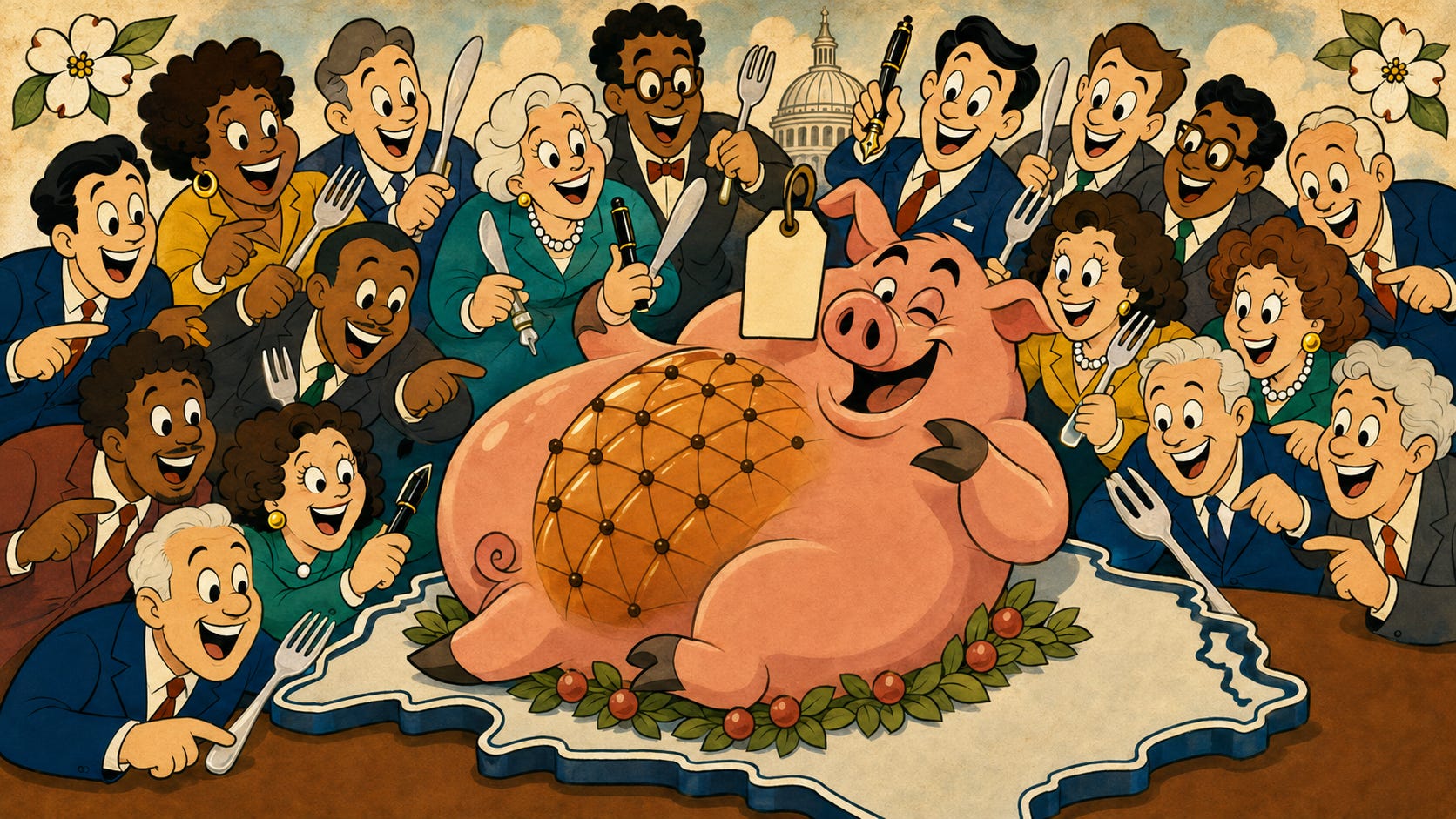
That may be the best summary of how power changes a political party. In 1994, Republicans worried that influence would tempt them to bring home too much pork. Today, the concern is that there might not be enough room on the label for everyone who wants credit.
I understand why majority lawmakers like earmarks. They help assemble votes, reward allies and give legislators something tangible to show constituents. Some of the projects are quite good.
But directing anything close to $2 billion toward particular projects through a process with little public debate and no named requester is a bad way to conduct state business.
Hayes’s prediction did not hold up: Once Republicans gained influence, the pork eventually started rolling in. That is unlikely to change. But now that nobody is embarrassed by it, there should be no objection to putting names on the label.
At a premium

Top spenders on social media last week
Question of the week
A rare consensus last week: 97% of you said that lawmakers should revisit the prediction markets issue when they come back into session.