
North Carolina was hardly a pioneer when it legalized online sports betting. By the time the first bets were placed here in 2024, more than half the country had already moved in that direction.
Prediction markets are a different story. With a short section in the new state budget, North Carolina appears to have become the first state to expressly welcome prediction market gambling while giving up virtually all state authority to oversee it.
While it’s largely been overlooked, this is a fundamental statement about who should control a rapidly growing form of gambling and whether North Carolina intends to have much of a say at all.
When it goes into effect on Jan. 1, 2027, it would place North Carolina at the most permissive edge of an unsettled national fight over gambling, federal power and state regulation.
When lawmakers return later this month for a budget corrections bill, they should repeal this section and return the state to the position it occupied just a few weeks ago.
That wouldn’t settle the national debate over prediction markets. It would simply allow North Carolina to have that debate before giving away its leverage.
North Carolina’s unusually permissive position
Prediction markets — including platforms such as Kalshi and Polymarket — have quickly become the center of one of the biggest legal battles in American gambling.
The Commodity Futures Trading Commission’s position is straightforward: Event contracts traded on federally registered exchanges are financial derivatives under federal law, not gambling products subject to regulation by individual states.
The CFTC has repeatedly argued that it has exclusive authority over those markets. It has filed briefs supporting prediction-market operators and lawsuits seeking to prevent states from applying their gambling laws to federally registered exchanges such as Kalshi and Polymarket US.
Most states have not been willing to accept that argument.
Their resistance has been broad and bipartisan. State attorneys general and gaming regulators have brought lawsuits, issued cease-and-desist orders and defended the states’ longstanding authority to decide whether and how gambling takes place within their borders.
Many of the states resisting that argument are led by Republican attorneys general or conservative legislatures. Their position is that attaching the label “financial contract” to a wager on a football game should not automatically allow an operator to bypass state gambling laws.
Kentucky took a more cautious middle course. It chose to tax prediction-market activity but expressly declined to treat that decision as legalization or as a surrender of state authority.
North Carolina did the opposite.
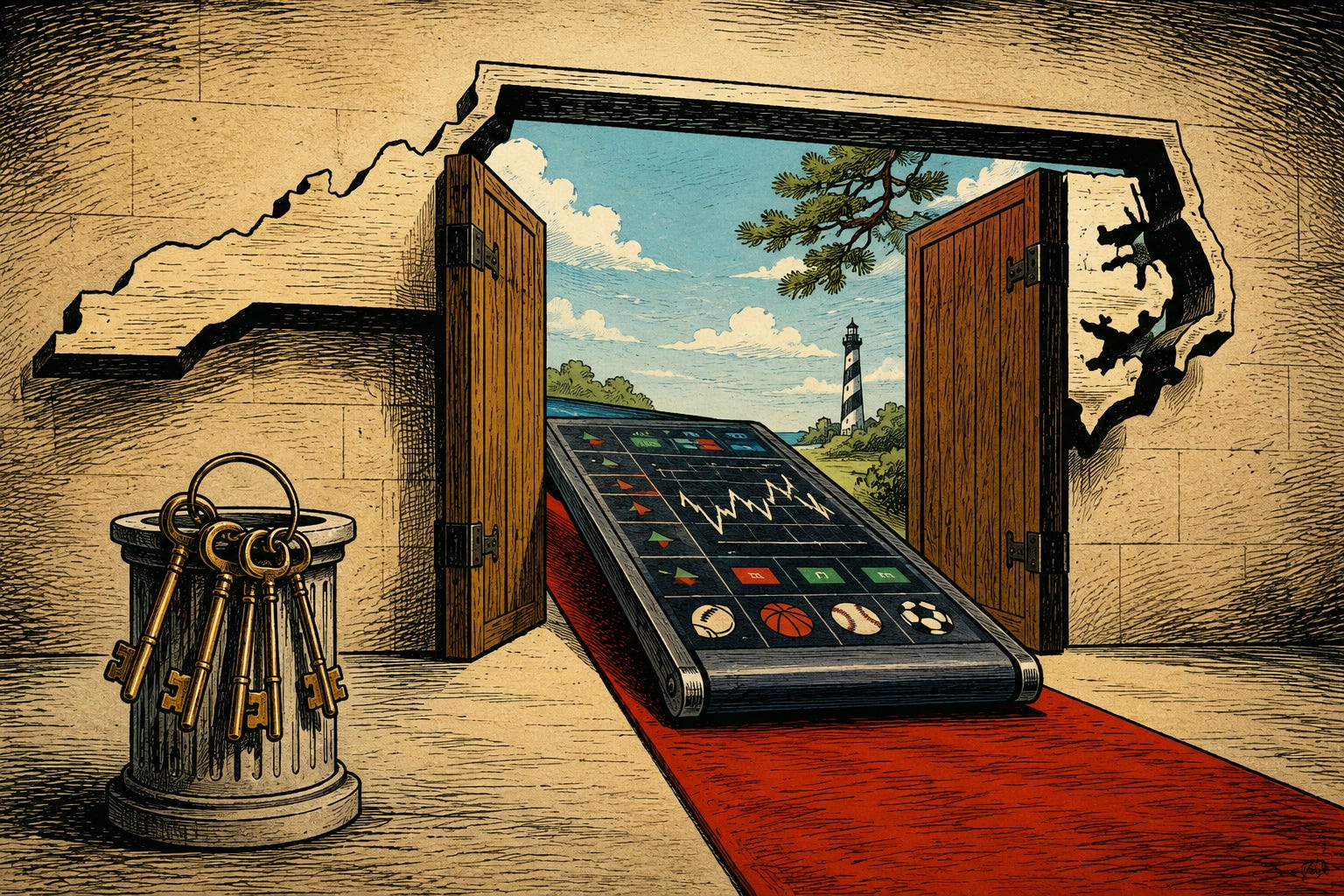
Section 44.9 of the new state budget imposes a 6% tax on prediction markets’ net trading-fee revenue. But it also expressly recognizes exclusive federal regulatory authority and says North Carolina will impose no licensing, registration or other regulatory obligations of its own.
That appears to make North Carolina the first state to write the prediction-market industry’s preferred legal theory directly into state law.
The courts have not conclusively resolved whether the CFTC or the states are right. North Carolina nevertheless decided the issue for itself — and entirely in favor of federal control.
Whether that ultimately proves to be the correct legal interpretation is almost beside the point.
What is remarkable is that North Carolina voluntarily embraced it before it had to. Rather than preserve its authority to establish age requirements, consumer protections, licensing standards or limits on particular kinds of contracts, the state agreed to stay out of the way.
If you’re concerned about gambling, this should concern you
My own position on gambling has never been a secret. If I were designing North Carolina’s laws from scratch, sports gambling would not be legal.
But that isn’t the question facing lawmakers today.
The more immediate question is whether North Carolina should voluntarily surrender its ability to regulate an entirely new category of gambling before deciding what rules ought to apply.
Prediction markets have already produced controversies that illustrate the moral and practical problems surrounding wagers on real-world events.
ABC News reported that President Donald Trump’s longtime White House teleprompter operator is believed to have earned more than $100,000 trading on Kalshi contracts tied to what Trump would say in his speeches.
Federal prosecutors have also charged an active-duty Army soldier stationed at Fort Bragg with using classified information about a planned military operation to capture Nicolás Maduro to make more than $400,000 through Polymarket trades. Those remain allegations, and the soldier is entitled to the presumption of innocence.
Neither example proves that state regulation could prevent every abuse. They do show how quickly prediction markets can create incentives to exploit privileged information about political decisions, public officials and even military operations.
When new forms of wagering emerge, states normally preserve the ability to respond. They debate consumer protections. They establish licensing requirements and age limits. They decide which subjects should be off-limits. They retain the authority to adapt as new problems arise.
North Carolina’s budget moves in the opposite direction.
Instead of asking what guardrails should exist, it largely gives up the state’s ability to build them.
Prediction markets are increasingly sports betting without the state rules
There is another reason this budget provision deserves scrutiny. Most people still associate prediction markets with election forecasts or quirky wagers about politics and popular culture.
Visit the home pages of Kalshi or Polymarket, however, and something else becomes obvious: Sports dominate.
Prediction markets increasingly compete directly with traditional sportsbooks. The difference is that licensed sportsbooks in North Carolina operate within a regulatory framework designed by North Carolina.
They must obtain state licenses, pay a 23% tax on gross wagering revenue and comply with North Carolina’s age requirements, responsible-gambling rules, integrity safeguards and regulatory oversight.
Federally regulated prediction markets have their own compliance obligations. But the new budget expressly says North Carolina will impose no state gaming license, registration or other regulatory obligations on them. They will not have to follow the state’s sports-wagering framework or answer to North Carolina gaming regulators.
The economic activity looks remarkably similar. Consumers are placing money on the outcomes of sporting events.
North Carolina’s legal sports-betting market was designed to generate revenue for public priorities while requiring operators to meet state consumer-protection standards. If customers migrate from licensed sportsbooks to federally regulated prediction markets, the state could collect less revenue while still bearing many of the resulting social, enforcement and consumer-protection costs.
The American Gaming Association, which represents the state-regulated gaming industry and therefore has an interest in this debate, estimates that states have missed out on more than $1.1 billion in potential gaming-tax revenue since prediction markets began offering sports contracts.
That figure should be treated as an industry estimate, not settled fact. But the underlying concern is obvious.
Even people who support legal sports betting should ask a simple question:
Why should North Carolina encourage a parallel sports-wagering market that plays by a completely different set of state rules?
Fix it before it takes effect
None of this requires lawmakers to decide whether prediction markets should ultimately operate in North Carolina. Reasonable people can disagree about that.
What does not make sense is allowing North Carolina to become the nation’s most accommodating jurisdiction for prediction markets through a budget provision that received little independent scrutiny.
The upcoming budget corrections bill provides an easy solution.
Repeal Section 44.9 and return North Carolina to the status quo that existed before the budget passed.
Allow the courts to resolve the federal questions. Allow lawmakers to consider prediction markets through a standalone bill with committee hearings, expert testimony and public input.
I’d still prefer to see gambling far more limited than it is today, but that isn’t the realistic choice before the General Assembly.
The realistic choice is whether North Carolina should give away its authority before deciding how this new industry ought to operate.
It shouldn’t. Lawmakers still have time to fix that mistake.

What has happened to our Legislature? They no longer represent the People.
First is allowing Flock cameras along all our highways with NO 4th Amendment safeguards in the new law. No regulation regarding who has access, how data is accessed, how long it is kept, when do you need a warrant, how misidentification is handled, etc.
Now this give away to the prediction markets.
Are our legislators too lazy to do it right? Or have they all been bought off‽