
With gas prices again nearing historic highs across the country, states are under increasing pressure to DO SOMETHING about it.
That something tends to be suspending the gas tax. States like Georgia, Indiana, and Ohio have all approved gas tax holidays over the last few weeks, and now North Carolina looks ready to join them.
As you may have heard, over the weekend House Speaker Destin Hall and Senate leader Phil Berger announced a special session to address fuel prices. House Majority Leader Brenden Jones says lawmakers are coming back this week, with temporarily eliminating the gas tax among the options.
As Democrats have been quick to point out, there’s obviously a bit of political theater here, with November’s elections a month away. Lawmakers need to be seen as doing something about gas prices — especially diesel that’s now consistently over $6 a gallon.
My gut reaction was to criticize a potential gas tax holiday in North Carolina as shortsighted, but I get why lawmakers are reaching for it. They can’t do much about world oil prices or the conflicts disrupting supply. They can take some of the tax off the next fill-up.
That’s one of the few ways they can help people quickly, and I certainly understand why they’d want to.
About North Carolina’s gas tax
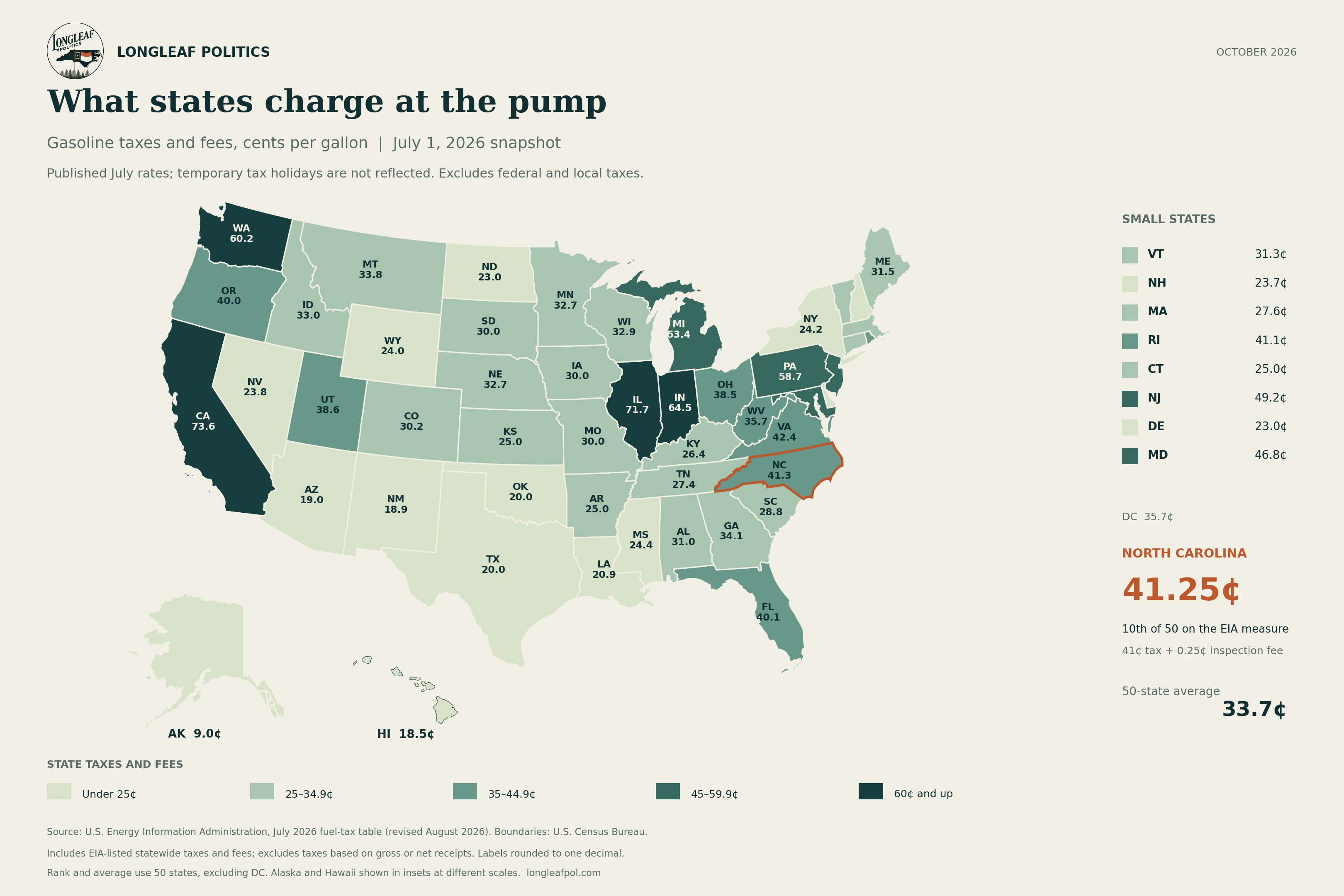
As anybody who’s ever driven across the border into South Carolina to fill up knows, North Carolina has one of the highest gas taxes in the country.
North Carolina’s motor-fuel excise tax is 41 cents a gallon, plus a quarter-cent inspection fee. That puts our state 10th-highest among the 50 states, according to the Energy Information Administration. South Carolina’s statewide taxes and fees total 28.75 cents, Tennessee’s 27.4 cents and Virginia’s 42.4 cents.
After a small environmental allocation, 75% of the remaining fuel tax revenue goes to the Highway Fund and 25% to the Highway Trust Fund. The Highway Fund primarily pays for road maintenance and operations. The Trust Fund helps pay for new road construction and expansion.
Why our gas tax is so high
North Carolina has been taxing gasoline since 1921, when a penny-a-gallon tax and a $50 million bond issue helped then-Gov. Cameron Morrison build roads connecting our county seats. The Good Roads State had to pay for those roads somehow.
There are really two big reasons why North Carolina’s gas tax is so high. The first is that our state government builds and maintains a lot more roads than most other states do.
North Carolina took over county roads in 1931, and the N.C. Department of Transportation now maintains an 81,000-mile network that includes a ton of roads that counties handle in many other states.
The second reason is that North Carolina has chosen to collect much of the money to build and maintain that network from drivers — but without relying on tolls so much. Gas taxes, taxes on vehicle purchases and DMV fees supply most of our state transportation funding.
My analysis of federal highway figures shows that fuel taxes supplied 36.5% of North Carolina’s state-government highway receipts, excluding borrowing. The national figure was 20.3%. Only Indiana and Alabama relied on fuel taxes more.
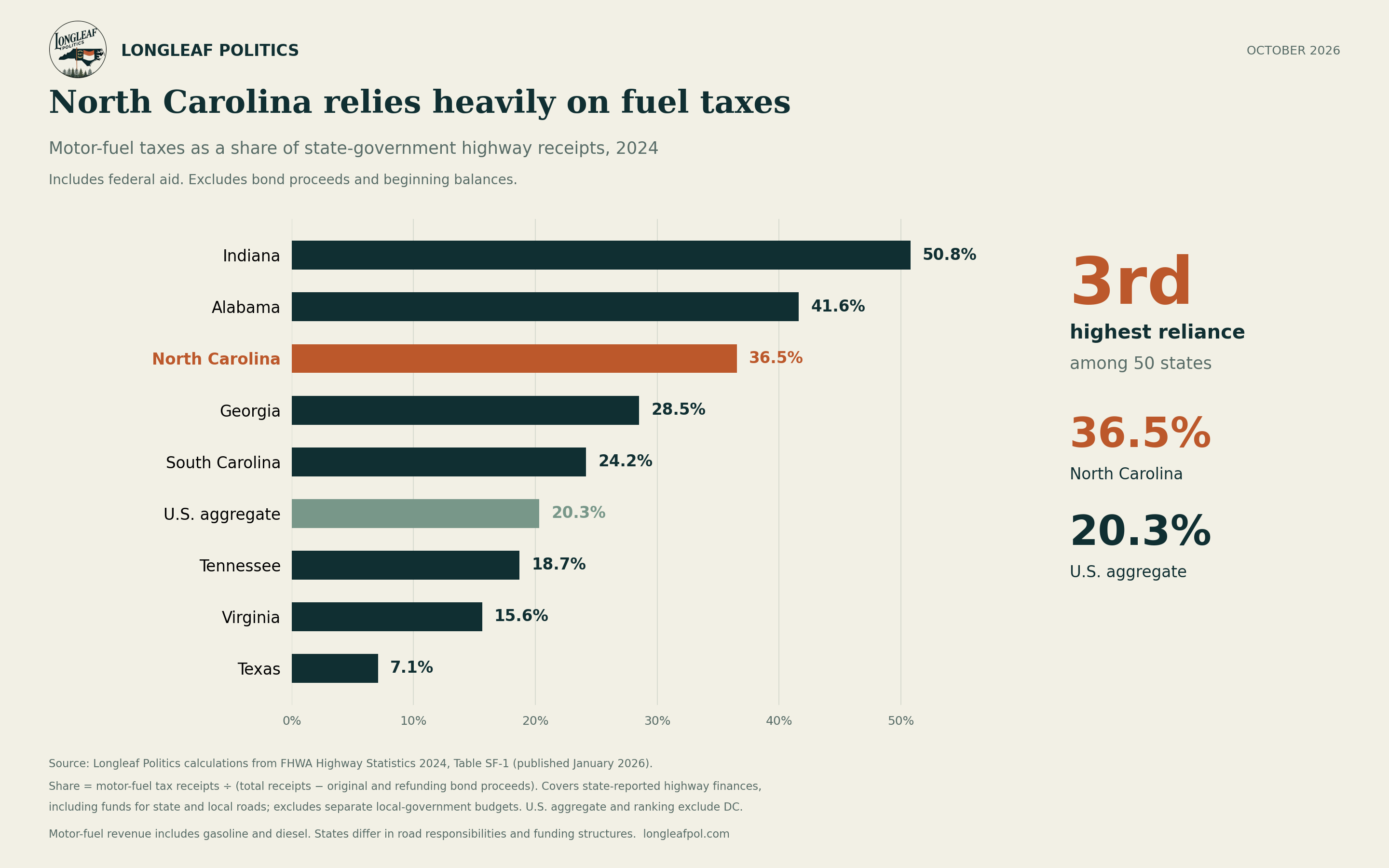
This isn’t necessarily a bad thing. It’s simply a trade-off. So how do states that depend less on the gas tax pay for roads? Mostly by supplementing gas taxes with other tax revenues.
Virginia supplements its fuel taxes with dedicated sales taxes. Texas uses portions of sales-tax collections and oil-and-gas production taxes. North Carolina has started moving that way, too, now sending 6% of net state sales-tax collections to transportation.
The reality is that taxpayers pay for roads one way or another. Collecting more at the pump means less need to raise that money through income taxes, sales taxes or tolls. A high gas tax can leave room for lower taxes elsewhere.
What a gas tax holiday would do in N.C.
Say North Carolina does go ahead with a gas tax holiday. What would drivers get out of all this? If the entire 41-cent tax cut reached consumers, a 15-gallon fill-up would cost $6.15 less. While that’s not life changing, it is real money, especially if you drive a lot.
But drivers may not get the full savings. A Wharton study of gas tax holidays in 2022 found that consumers received much of the benefit, though generally less than the whole tax cut.
In North Carolina, Wharton estimated that a gas tax holiday would net out to a reduction of 30 cents per gallon in gas prices. That would save about $4.50 on a 15-gallon fill-up.
I suspect the bigger effect would be psychological. You’d see a lower number on the sign and feel like somebody was trying to give you a break. When every trip to the gas station feels like bad news, that counts for something.
On the flip side, the same model puts the revenue loss from a two-month gasoline-and-diesel tax suspension at about $401 million. If the General Assembly chooses to suspend the gas tax, I’d expect lawmakers to appropriate general-fund money to cover the gap, as Ohio just did.
A holiday won’t solve the problem
The reality is that there’s only so much a tax holiday can do. It doesn’t put any more gasoline on the market. In some ways, it can be counterproductive: If cheaper gas encourages people to buy more while supplies are tight, the price of the gas itself can rise and eat into the savings.
That puts a limit on how much relief Raleigh can deliver. And there’s also the inconvenient reality that the tax would have to come back at some point, and nobody wants to be responsible for a huge, sudden jump in gas prices.
Still, I can support giving people a short break this session. Replace the lost road money, set an end date and be honest that we’re just getting a little relief while we wait for the bigger supply problems to ease.
What I wouldn’t support is letting road projects fall behind or extending the holiday every time that end date becomes politically inconvenient.
Longer-term, I do think it’s worthwhile for North Carolina to start weaning ourself off the dependence on gas tax revenue. Cars keep getting better at using less of it, and that’s a problem even after prices come down.
I’m open to cutting the gas tax permanently and paying for roads another way. If this special session gets that conversation started, it could do more good than a few weeks of cheaper gas.

Question of the week
On a lighter note, I’m a big fan of all those online quizzes that let you answer some questions and determine what type of philosopher you are or what your political typology is. But I had yet to see one specifically for North Carolina. So I made one myself.
Have at it: Which North Carolina political tradition fits you? Answer 24 quick questions to find your closest comparisons and a result worth sharing.
Very informative. Thanks.
The advantage of the gas tax is it is proportional to how much you use the roads. Given this, we would then need to figure out how to tax EV drivers and future EV trucking proportionate to their road use, especially as cars weigh more than their ICE equivalent.
Also, out of state vacationers and truckers contribute to this revenue.