
It may surprise you to learn that my favorite podcast has nothing to do with North Carolina politics. It’s actually about small business acquisitions.
Each week, the hosts of Acquisitions Anonymous review the listing for a business up for sale and decide whether they would consider buying it. These folks are serious investors and operators, which means they notice all the little red flags that most of us would miss.
They’ve done dry cleaners, HVAC companies, funeral homes, franchises and even, one time, a worm farm.
Last week, their eyes landed close to home: Spruce Pine, North Carolina.
The crew evaluated the listing for City Drive-In, the 75-year-old restaurant that serves as the town’s front porch.
That this historic property is for sale is apparently news. At least, I have not seen it reported anywhere, and it’s a pretty big deal. I hope the eventual buyer is somebody with a heart for the town and for its history. You can see the listing for yourself here.
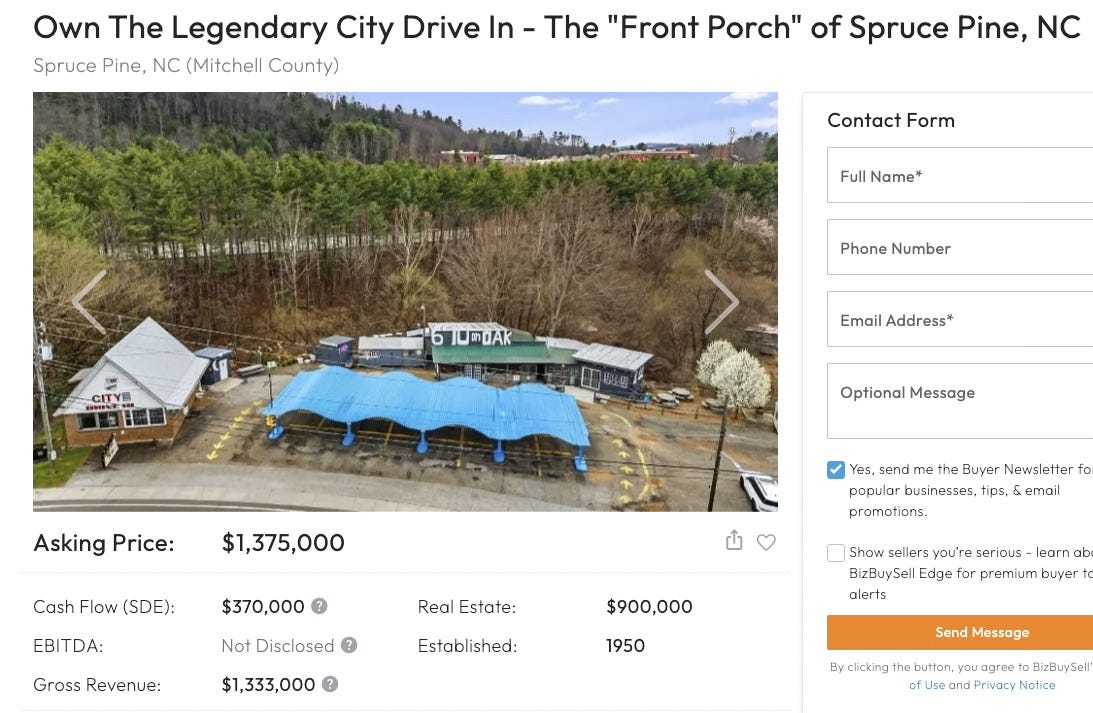
But the details of the sale are not what I want to focus on here. What was striking to me was how the investors talked about the town. Not in a bad way, by any means. Just different. And considerably more blunt.
“I think your biggest risk here is if somehow this town dies,” one host said.
Now, I love Spruce Pine. I’d say it’s my favorite little town in North Carolina, and that makes it very easy for me to look at it with rose-colored glasses. So do most folks who typically discuss the town and its trajectory. Town managers, the Chamber of Commerce, the economic development folks, all have a natural interest in emphasizing the positive.
The easy version is a mountain town with good people and a beautiful backdrop, slowly but surely driving toward a brighter future.
The hosts were not in a position to judge all that. They had not been to Spruce Pine, and they were not doing real due diligence.
But they did ask the questions a serious investor would ask, and they’re not the ones you typically hear in polite civic circles. Would someone want to build a life there? Can the town keep enough people coming through the door?
Where Spruce Pine really stands
I’m not going to pretend like I have the final verdict on the town, either. I don’t get up to Spruce Pine nearly as much as I’d like. But I’ll tell you what I see.
Spruce Pine is a different type of mountain town than a place like Boone, Blowing Rock or Highlands. It is considerably less polished and more blue collar, much more of a mining town than a tourist one.
In a lot of ways, that is a huge asset. You go there for a slower pace, and you can actually afford to buy real estate there. Spruce Pine has not been whitewashed into a resort town, and I hope it never is.
But it also limits the growth story. Mitchell County as a whole drives far less tourism revenue than most other mountain counties.
Mitchell County had only $46.6 million in tourism spending in 2023 (I used pre-Helene numbers, for obvious reasons). In comparison, Avery had $259.5 million. Haywood had $350.2 million. Watauga had $517.5 million. Buncombe had nearly $3 billion.
You feel that when you’re there. A few weeks ago, I wrote about Mt. Airy and how it’s really leaning into the Mayberry marketing with a good amount of success.
It would be a harder road for Spruce Pine to do something like that. It’s not really set up like a destination town. The Ingles is still closed after Helene, leaving Mitchell County with one supermarket, Walmart. Downtown has some good places to eat and shop, but not enough retail to make a full weekend work the way it would in a more mature visitor town.
Spruce Pine was hit extremely hard by the hurricane, with the North Toe River flooding much of downtown. It is climbing back, but even before the storm it had challenges.
The Town of Spruce Pine streetscape plan is a good example. The town council recently got a rundown on the vision, featuring wider sidewalks, landscaping, outdoor dining, more places for people to spend time downtown. That is exactly the kind of thing Spruce Pine needs if it wants more visitors lingering.
Here’s the catch. The estimated total cost is about $34 million, while the town’s entire General Fund budget is about $3.35 million per year.
That is the Spruce Pine challenge. The town has real promise. It also has small-town math.
The TV show
What does that mean for City Drive-In? I’m not sure. But it would be enormously useful for Spruce Pine, and for small towns all over North Carolina, to ask these sorts of questions out loud.
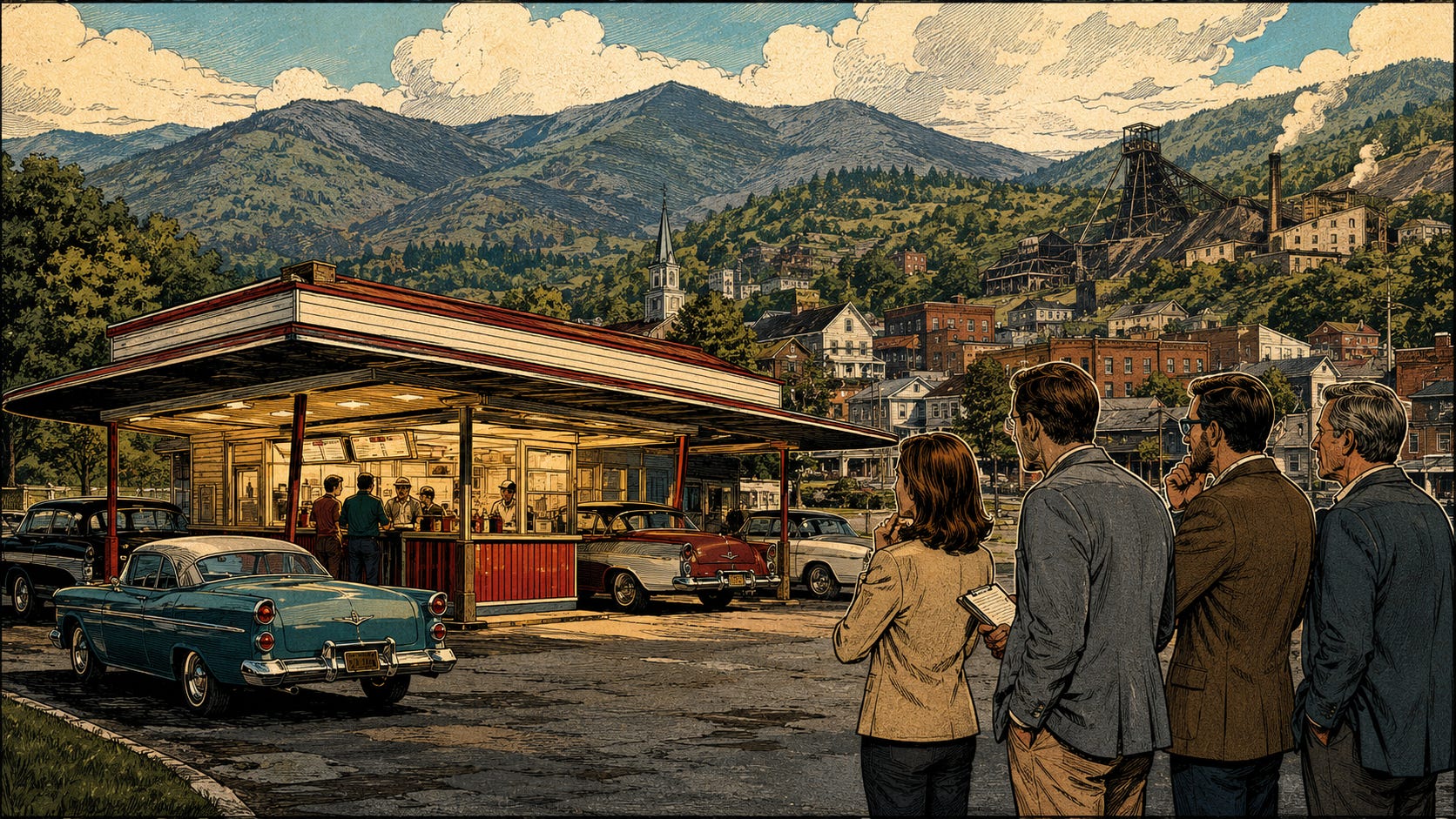
I almost want to see the Acquisitions Anonymous crew roll into Spruce Pine for a week, talk to the owners, the town, the bankers, the employers, and the people who actually eat there on a Tuesday, then give us a readout on how an investor would look at the business’s — and the town’s — future.
Honestly, that would make a great reality TV show.
It would also fill a real gap. Economic development leaders know their towns from the inside. Investors see a different set of risks. Small towns need both views if they are going to succeed.
At a premium


Question of the week
I’m trying to track down a specific kind of North Carolina legislative artifact.
On the Do Politics Better podcast1 a few weeks back, Sen. Phil Berger told a story from when Democrats controlled the N.C. Senate: Republican bills were often sent to the Senate Ways and Means Committee, which rarely or never met.
Berger said he would write to Sen. Charlie Dannelly, the committee chair, asking for bills to be heard. Dannelly would send back a formal reply saying, essentially:
“Sen. Berger, the bill you reference will be heard at the next Senate Ways and Means Committee meeting.”
I’d love to find any example of this kind of correspondence. Does anyone know whether one still exists — in legislative archives, personal papers, old Senate files, or someone’s box of political memorabilia? I’d be grateful for any leads.
Yes, I do more than just listen to podcasts, even if it doesn’t seem that way.
Fascinating and quite thought-provoking. Coming from the over-developed coast, where we're always fighting off the latest "great" idea to ruin lives and non-tourist livelihoods, I hadn't thought about the challenges from the other direction. Good luck and God speed to the good folks of Spruce Pine!
Off the topic, but...
A little known fact about Spruce Pine that makes it strategically important: it is the site of the purest quartz mine in the World. Unfortunately, I believe it is still owned/controlled by the Chinese government. Why is that important? Well, the established (Czochralski) process for growing extremely pure silica wafers requires a 100% pure quartz crucible for heating the silica to high temperatures, then forming ingots for slicing. The semi-conductor industry relies exclusively on quartz from the Spruce Pine mine for those crucibles. Thus, virtually every computer chip, in virtually every server used in every data center in the WORLD, is 'grown' in quartz crucibles from Spruce Pine, NC.