
My daughter was sitting next to me the other day while I filled out one of her forms for school. It was about her academic strengths, so it took a good bit of verbiage to fully capture.
“What are those scribbles?” she asked me, pointing to my hurried script.
It was a pretty sick burn about my handwriting, sure. But it also made me realize she had never been exposed to writing in cursive.
My favorite hobbyhorse is advocating for a new constitution for the state of North Carolina. But if I had to pick a second, it would have to be pointing out the absurdity of our public education governance.
I’m aware that tomorrow is primary election day, but I’ve said about all I have to say about that until the results come in. So let’s talk about this instead.
Like most states, we made the mistake a long time ago of believing that the responsibility for teaching young children is best farmed out to the bureaucratic “experts” who are adept at writing scores of pages of curriculum standards but don’t have an answer for how to teach a kid math.
They find the time to administer plenty of standardized tests — MAPs and DIBELs and iReady and several others I know I’m forgetting — but can’t squeeze in teaching a child to write in cursive.
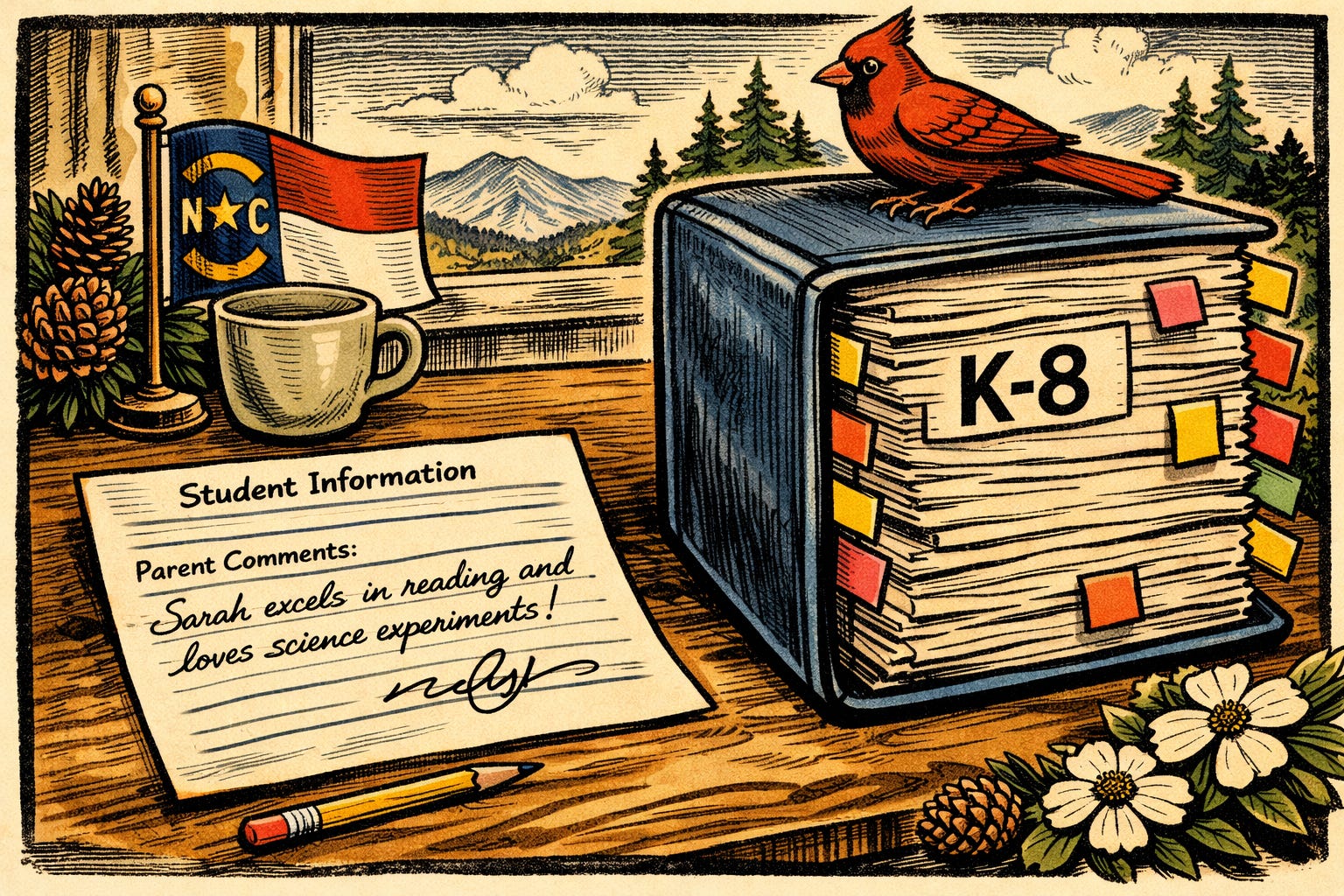
I’m still working on a project to figure out what, exactly, we’ve decided to teach students. So far, I’ve got a 520-page document that just includes the state’s “quick reference” guides for grades K-8. Feel free to take a look through it yourself.

If we can’t summarize a year of learning for a seven-year-old on one page, we’ve built something for administrators, not for families. In that kind of system, it’s almost impossible to hold anyone accountable for results.
So what’s my point? I have two of them.
First, North Carolina passed a law requiring cursive to be taught, and in practice compliance looks spotty. I actually do think it’s important for people to be able to read and write cursive. It’s a time-honored tradition that matters for reading founding-era handwriting and your grandma’s old recipe cards. Penmanship shouldn’t be a lost art.
When a requirement that simple doesn’t reliably show up in the classroom, it tells you the state doesn’t really have a way to check what’s happening.
But my main point is that I want the General Assembly to take back more control and be more proscriptive about what is taught in public schools. There should be a one-page document for each grade K–5 that tells us what kids are going to master that year — and there should be real oversight to make sure it’s happening. I’ll come up with my own suggestion in the coming weeks.
That’s the larger issue here. The state can’t clearly say what kids will master, and it can’t reliably check that it happens.
At a premium
If you care about property taxes, you’ll want to read a new special report I published on Saturday.
A state audit in Speed found thousands in unauthorized charges ran through town accounts for months, and the town is now moving toward dissolution. That sent me looking at the highest municipal tax rates in towns under 1,000 residents. In too many, a huge share of the budget goes to “general government” overhead — not services.
This one’s for legislators, county commissioners, local-government watchdogs, and anyone paying a steep town tax bill and wondering what they’re actually getting.

Also for premium subscribers last week:


I am an advocate for cursive handwriting. I had to take a special class in college on how to teach cursive! (This was in 1969).
Teach Civics! Be an involved parent—that’s the key to ensuring your child’s education.
Don’t blame the teachers, they don’t make the curriculum decisions.
And in Middle school, the teachers don’t even care if the kids are done with I ready/work. My daughter had unapologetically watched 9 episodes of Percy Jackson on her school IPad while the other kids other Iready.