N.C. schools are debunking America before they ever teach it
Corrective history has replaced an honest, hopeful story of America — starting in the early grades.
A few weeks ago, on Columbus Day as it happens, I was getting my kids ready for bed and decided to ask them what they’d talked about in school. The holiday came up, and my third-grade daughter jumped in right away.
“Oh yeah, Columbus! He’s a bad guy. He abused the native people,” she said with the excitement of somebody who’s just learned a juicy new fact.
Where’d you hear that? I asked her. “The librarian told us!” she replied, proudly.
I don’t really want to litigate Christopher Columbus in this space. He’s a complicated figure, like every human being who’s ever lived. He did heroic things and things that aren’t so admirable. That’s actually the norm when it comes to historical figures; Moses murdered a man, after all.
As adults, we can argue about all of that, and we should. But that’s not really what this is about.
What stuck with me that night was a different question: What do we want kids who aren’t ready for nuance to hear first about their own country?
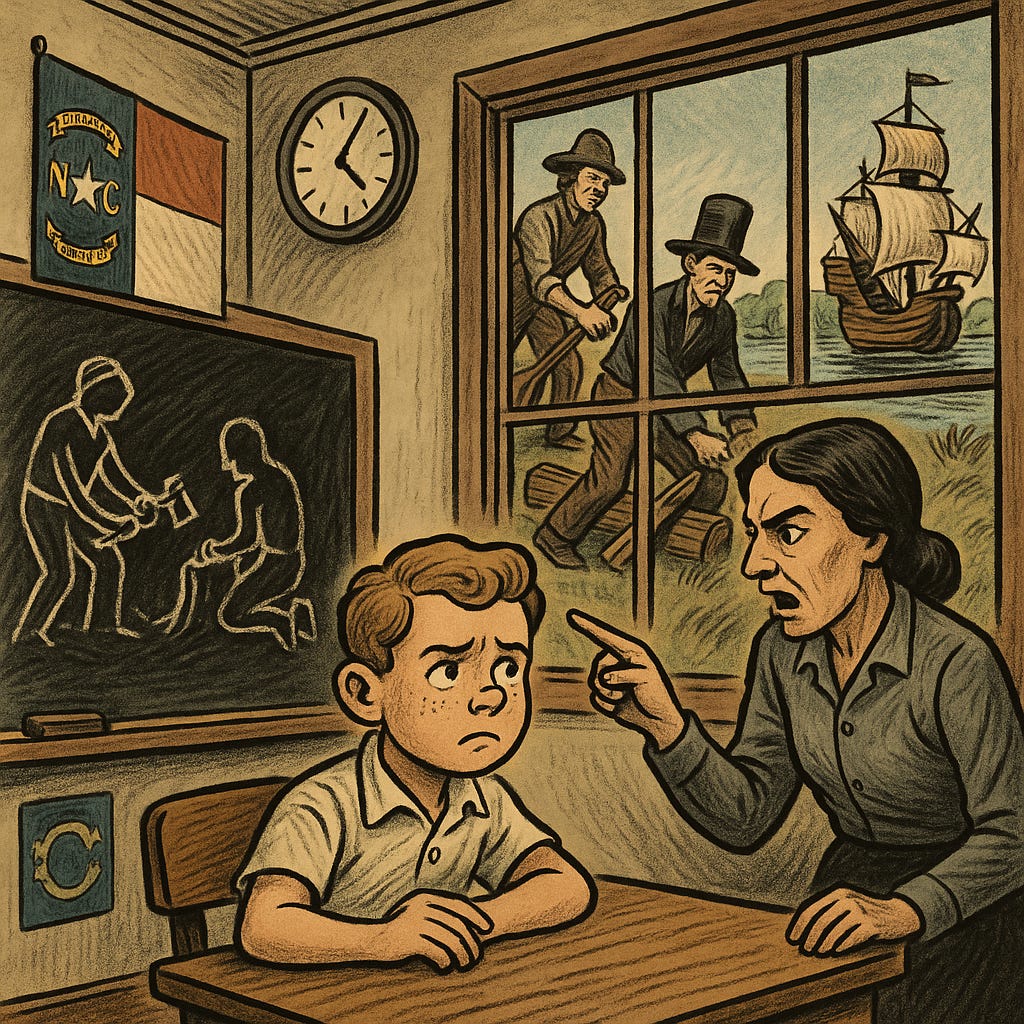
Parents still can’t see what’s really being taught
That short bedtime conversation set me off on a little quest to try to understand how my kids are actually learning history in their public school. If you’ve tried to answer that question yourself, you know how difficult it is.
You can find objectives. You can find “unpacking documents.” You can find endless pages of jargon-filled standards language.
But it’s still nearly impossible to determine what that actually looks like in the classroom. And of course, you can’t easily see what individual teachers — or librarians, for that matter — are adding on top.
The Parents’ Bill of Rights was supposed to move us toward transparency, but in practice, districts like Charlotte-Mecklenburg Schools have chosen to maliciously comply. There are new forms, new policies, new emails.
But I don’t actually know much more about what my children are being taught than I did before the law passed, and it’s not for lack of trying.
North Carolina is still stuck in the assumption that “experts” should decide what children are taught, with parents and legislators relegated to the sidelines. It ought to be the other way around.
Right now, the State Board of Education has enormous power to shape what actually gets taught in North Carolina classrooms.
The General Assembly has dabbled around the edges in recent years, requiring things like financial literacy, cursive writing, and multiplication tables. Those are good impulses, but they don’t go nearly far enough (and my kids have never been exposed to either cursive or times tables, for what it’s worth).
We’re teaching the takedown before we teach the story
Which brings me back to Columbus.
I’m reading a book right now called Rescuing the American Project. One of its main arguments is that a healthy, ordered nationalism, an appropriate love of country, is essential if the United States is going to hold together.
It’s hard to argue with that, notwithstanding that “contemporary nativists have appropriated American nationalism and gutted it of its original public meaning,” as the authors lay out.
That doesn’t mean pretending America is perfect. It means recognizing that we are a nation with story that is a fundamentally good one, one that’s worth knowing and defending. And teaching.
Think about the stories many of us learned when we were young:
George Washington and the cherry tree
Abraham Lincoln splitting rails and studying by firelight
The Pilgrims and Native Americans at Thanksgiving
Columbus sailing into the unknown
All of those stories are simplified, and some are more apocryphal than real. But all of them were meant to point beyond themselves — to courage, honesty, sacrifice, gratitude.
Kids today often don’t hear them at all. Or if they do, it’s through a debunking lens.
As the authors of Rescuing the American Project write:
“Differing interpretations of history will always be present, and those interpretations will inevitably change as newer perspectives come to light. But the long-term trend of corrective history, which has picked up as of late, has taken this much too far, to the point where scoring points against an inspirational history seems to have become the objective.”
When I read North Carolina’s official curriculum standards and “unpacking” documents, this is all too true. Even in the lower grades, the emphasis falls on power, oppression, and critique, before children have any framework for why this country exists and why it’s worth caring about.
That’s bad sequencing. And with kids, sequencing is everything.
This is a job for the General Assembly
This is not a problem that requires pages of educrat mumbo-jumbo. At its core, it’s a simple, democratic one: What do we want North Carolina’s children to know and be able to do at each grade level?
That’s a job that properly belongs with the people, through their representatives in the General Assembly.
Here’s what I’d like to see:
A long, public process led by the General Assembly to define clear, plain-language expectations for each grade.
Standards written so a normal parent can read them in one sitting and understand them.
Those expectations passed into law.
The State Board of Education left to handle the mechanics — textbooks, pacing, assessments — within those guardrails.
On history and civics, that means choosing to tell an honest, hopeful American story. Not propaganda. Not self-loathing. A story that begins with gratitude, then adds the hard parts as kids are ready for them.
What I want my kids to hear first
As a dad, I want my kids to know the truth about our past, including the injustices and failures. As a Christian, I know every nation and every person falls short.
But I also want my children to see America as a gift. Something they’ve been entrusted with, not something they’re being trained to despise.
A third-grader coming home knowing only that “Columbus was a villain” isn’t an earth-shattering moment, but it reflects the tone for how kids learn about their country. Right now that tone is being set by people who never have to answer to parents.
The General Assembly can change that.
Quick hits
My newspaper column this week talked about how Mecklenburg leaders are treating Iryna’s Law like a crisis, but it’s one they built themselves. Charlotte actually has less jail capacity than a decade ago even as other counties are expanding. Read the column here, free with gift link: Mecklenburg’s jail ‘crisis’ is self-inflicted
If you haven’t read House Speaker Destin Hall’s op-ed arguing for the House version of the state budget, you absolutely should. I love to see political leaders taking their arguments directly to the public. It’s something the GOP has not done nearly often enough in recent years.
There’s been another stabbing on the Charlotte light rail, this time (allegedly) by an illegal immigrant with face tats. So much for increased security and fare-checking. But also, maybe Border Patrol should have picked up this guy instead of driving around my neighborhood looking for landscapers.


The EL Curriculum used in all K-8 teaches environmentalism, anti-colonialism, good vs bad Islam ( I am Malala in 3rd grade). Peter Pan unit in 3rd grade preps the kids with a passage the teacher reads to explain that women were forced to stay home but they wanted to work - in the early 20 th century! And the trauma porn in middle school - pandemic and refugee novels. Forget US history, my kids learned about South Sudan. And parents have no idea and don’t care.