
It feels like it has been a lifetime since tax policy was an actual political issue in North Carolina.
That may be about to change. House Speaker Destin Hall has floated the idea of a constitutional amendment referendum on property tax limits, and lawmakers in both chambers have started giving the issue real attention. What once felt like a niche policy discussion is starting to look like a real political question heading into the fall. I love it.
Property taxes are one of those issues that cut across red states and blue states alike. Almost everybody is wrestling with the same basic problem. Home values are up, tax bills are too, and voters of all stripes get angry about that.
Most states have put some kind of guardrails in place for what local governments can charge. Some are pretty strict, while others are loose.
North Carolina today is on the more lenient side. Our only real statewide rule is a simple cap on the property tax rate at $1.50 per $100 of value1. That’s a pretty high ceiling (a $4,500 annual bill on a $300,000 house), so it doesn’t come into play that often.
Because so many states have worked on the issue, there is no shortage of levers North Carolina could pull to try to rein in property taxes more. The House already seems to have settled on one of them: levy limits.
I think that is the right direction. But this is the kind of issue that can get confusing fast, so I want to slow down and walk through it carefully. What exactly is a levy limit? Why is it better than the other approaches states have tried? Why does North Carolina need one? And what are the best arguments on the other side?
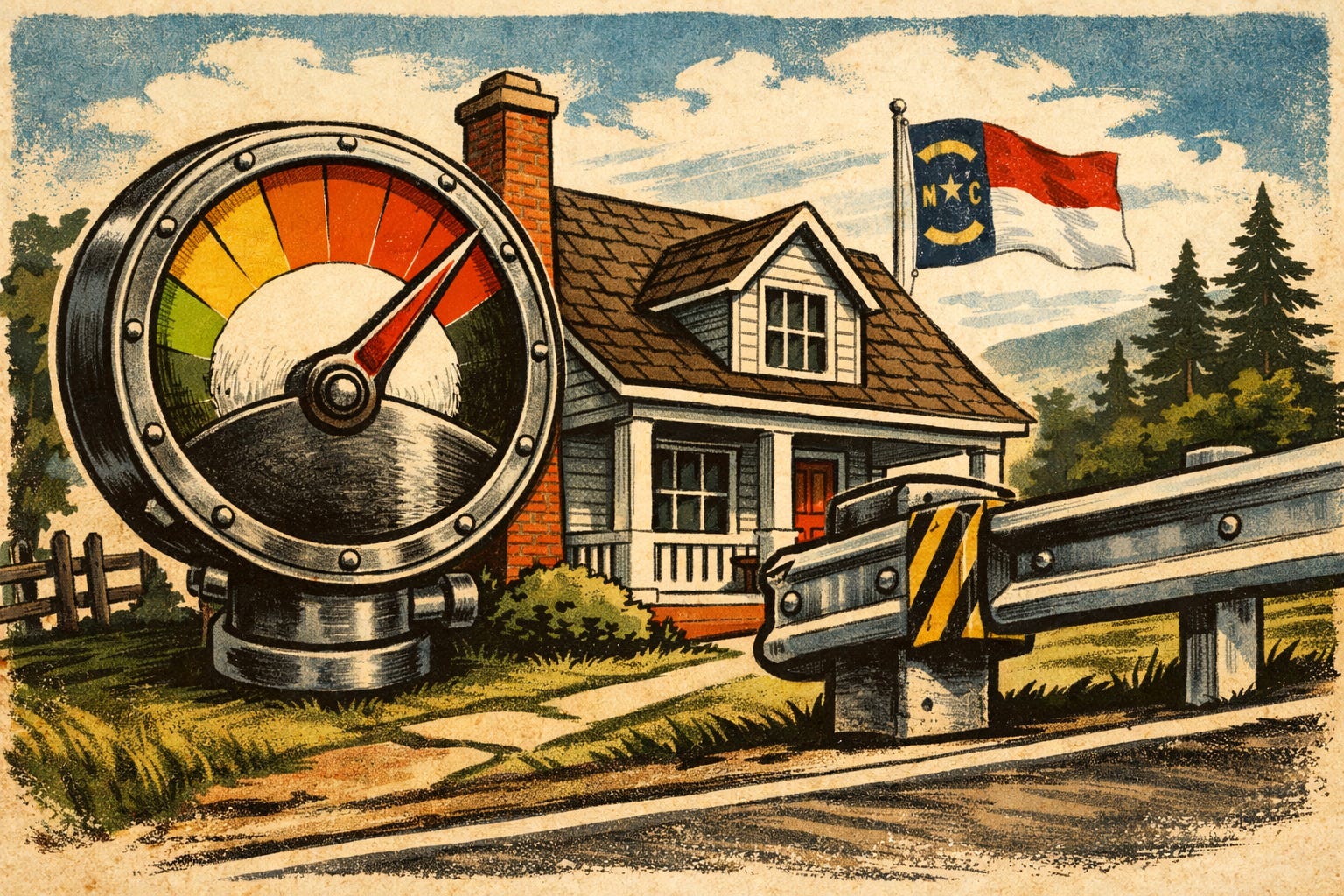
What is a levy limit?
A levy limit is a restriction on how fast a local government’s total property tax collections can grow from one year to the next.
Basically, it works like this. Say a town collected $100 million in property taxes in 2026 from a collection of homes and businesses. The next year, the town would be limited to collecting $100 million plus a small percentage increase from those same homes and businesses.
Levy limits usually allow that amount to rise with inflation, and sometimes with population growth as well. Oftentimes, the limit is somewhere around 2%. So in this scenario, the town could collect $102 million from these properties in 2027.
If property values rise faster than that formula allows, the tax rate has to come down.
One key thing to note is that new construction is typically excluded, which means growing communities can still collect additional revenue from actual growth. And if local leaders want to go above the limit, there is usually some sort of override mechanism, generally through voter approval.
Why levy limits are better than the alternatives
Like I said earlier, levy limits aren’t the only tool in the box. States have tried a number of different ways to limit property taxes, and most of them are bad. Here is a quick breakdown of a few of them.
Assessment caps
Assessment caps limit how quickly a home’s taxable value can rise each year, even if the market value rises much faster. That sounds good until you look at what it does over time.
For example, say you bought a house in 2020 and it was assessed at $300,000. You’re taxed on that assessed value. You live in a hot housing market, though, and the actual value of your home jumps quickly. By 2026, say it’s worth $500,000.
But because of assessment caps, you are taxed on a much lower amount. With a typical 3% annual assessment cap, you’d be paying property taxes as if your home was worth closer to $360,000 in 2026.
However, if you sell the home, the new owner would immediately start paying property taxes on the actual value — $500,000.
That creates a lock-in effect. It discourages moving and home renovations, which can break the assessment cap.
Homestead exemptions
Homestead exemptions work differently. Instead of limiting how much a property’s value can rise on paper, they carve out part of a home’s value from taxation altogether.
Say your house is worth $300,000 and the state gives you a homestead exemption on the first $50,000 of value. Instead of paying property taxes on the full $300,000, you would pay them on $250,000.
That can be a real help, especially for seniors, disabled veterans, or lower-income homeowners who are feeling squeezed. North Carolina already uses versions of this approach for some of those groups, and I think that kind of targeted relief can make sense. If someone on a fixed income is genuinely at risk of being taxed out of their home, that is a real problem and government should take it seriously.
But homestead exemptions do not really fix the underlying issue. They help certain homeowners, but they do not stop local governments from continuing to collect more overall as property values rise. That makes them a useful supplement, but not a real answer to the broader growth problem.
Rate caps
Rate caps are simpler. They limit the tax rate itself rather than the total amount of money a local government can collect. The problem is that a rate cap focuses on the number on paper, not the amount of money government actually brings in.
Say a county has a tax rate of 60 cents per $100 of value. Home prices take off, and the taxable value of property across the county jumps by 25 percent over a few years. The county can keep the exact same 60-cent rate and still collect a lot more money. The cap never comes close to binding, but taxpayers still feel the increase.
And rate caps can be awkward in the other direction too. If property values fall sharply, a local government may need to raise the rate just to collect roughly the same amount of money for basic services. That can make the cap pinch at exactly the wrong time, especially in places with weaker tax bases or volatile property values.
So rate caps can be both too loose and too rigid. They often fail to stop revenue from rising fast when values surge, and they can create pressure when values drop.
That is why levy limits make more sense. They go straight to the real question: how much more money is government collecting from us one year to the next?
Why North Carolina needs to work on property tax limits
This is not some abstract tax debate. It is an affordability issue.
Since 2020, rising home values have pushed assessments up across North Carolina. That has meant bigger tax bills for a lot of families at exactly the moment they are already dealing with a higher cost of living. In a recent Carolina Journal poll, 77 percent of likely voters said property taxes are a burden on their household budget.
The problem is not uniform, though, and that is what makes this debate so important.
Some towns and counties have been relatively restrained. Others have used rising property values as an easy way to bring in more money without having to make as direct a case to taxpayers. Over the past decade, property tax revenue in some of North Carolina’s fastest-growing counties has far outpaced inflation and population growth. Cabarrus, Wake and Johnston counties are a few of the clearest examples.
That is why levy limits make sense. They are not a one-size-fits-all punishment for local government. They are a guardrail against the places that have gotten used to treating appreciation as a revenue machine.
In that same Carolina Journal poll, 73 percent said they would support a constitutional amendment requiring limits on local property tax increases by local governments.
The best arguments against levy limits
The strongest case against levy limits is practical. Local governments do have real responsibilities. They have to fund deputies, firefighters, EMS, schools, roads, and everything else.
Those costs do not always move in a straight line. A fast-growing county may need a new school sooner than expected. A rural county may struggle with fixed costs on a weaker tax base. If you write the rules badly, you can create real problems over time.
That concern is valid. It is also not a reason to give up on guardrails. Rather, it is a reason to write a smart levy limit.
A good levy limit should leave room for normal growth. It should account for inflation and new construction. And it should include a clear override path for cases where a community genuinely needs to go beyond the normal limit.
If a county really needs more money for a new school, more deputies, or major infrastructure, there should be a way to raise it. My preference is voter approval. Local officials should make the case openly, and taxpayers should decide. That is a healthier system than the one we have now, where rising property values can quietly produce more revenue without the same level of accountability.
I’ve also heard concerns about the state government stepping in where it doesn’t belong. I wrote about that more fully in a separate piece, so I will not relitigate it all here. The short version is that a levy limit does not erase local choice. It sets a statewide default, then leaves room for local governments to make the case for more when they have a real need.
That seems like the right balance.
A levy limit should not be designed to starve local government. It should be designed to force discipline.
Why I support levy limits
At bottom, I support levy limits because government should not get a windfall just because your house got more expensive.
That is what happens now in too many places. Local governments can pull in more and more money as values rise without ever having to make a clear case to taxpayers.
Levy limits draw a clearer line between growth that has to happen and growth that officials choose. Under the current system, those two things blur together too easily.
A county can wind up with a much larger tax take because values climbed, and taxpayers are left arguing after the fact about whether that was necessary, justified, or just convenient.
Levy limits do not end property taxes or freeze local government in place. They just force local officials to be more honest.
At a premium


Question of the week
You guys are not nearly as big a fan of politician March Madness brackets as I am. A near majority (47%) said you could take it or leave it.