
Today is Labor Day, which means politicians will spend the day praising North Carolina workers in the least controversial terms available.
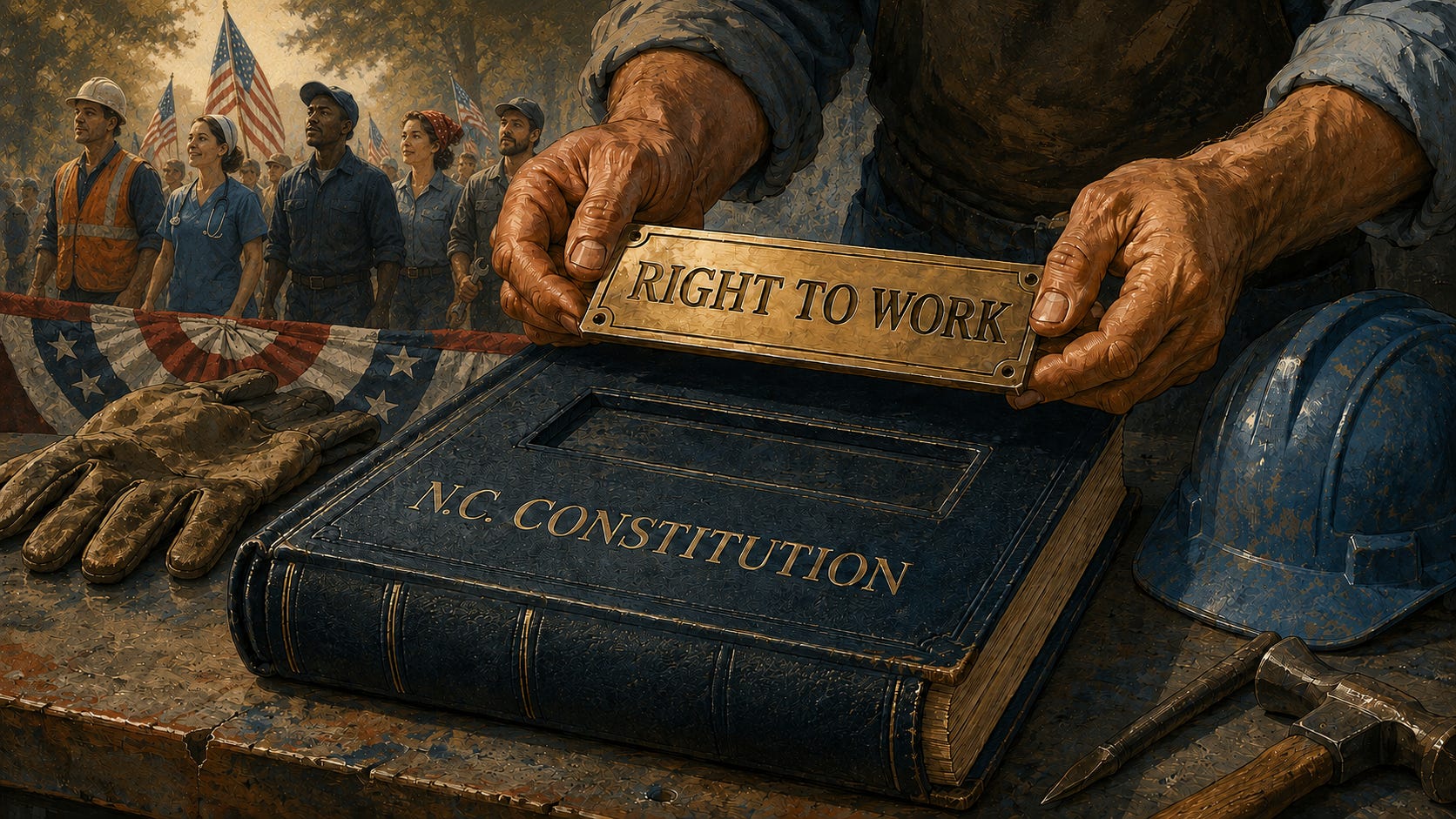
There’s nothing wrong with that, but I want to talk about a labor question on which people actually disagree: Should North Carolina put “right to work” in its constitution?
“Right to work” basically means you cannot be required to join a union or pay union dues as a condition of keeping your job. You remain free to organize and join a union; the choice belongs to you.
North Carolina has had a right-to-work law since 1947, and the freedom of choice it provides is the strongest argument for it. But it’s also become part of North Carolina’s economic identity. It is one of the advantages the state’s economic developers advertise to prospective employers, alongside low taxes and a strong workforce.
Democrats see it differently. They argue that right to work weakens unions by reducing the membership and dues that support collective bargaining.
Of course, the alliance is also political. Democratic candidates remain the overwhelming beneficiaries of union political spending. On average, union PACs direct about 94% of their contributions to Democrats.
If Democrats take control of the General Assembly, they will almost certainly undo our state’s right to work law. The state Democratic Party has called for repeal, and Democratic legislators have introduced a bill that would do it.
That possibility is the case for constitutional protection. Yet Republicans have repeatedly failed to send the question to voters.
Twice the General Assembly has come close. In 2017, the House approved an amendment 75–44, only for it to stall in the Senate. This year, the Senate approved one 30–16, only for it to stall in the House.
I reached out to Mitch Kokai, senior political analyst at the John Locke Foundation, to get his take on why this hasn’t gone on the ballot. The Locke foundation has long advocated putting right to work in the state constitution.
He told me he thinks Republican lawmakers simply see little immediate danger while they remain in charge. He also thinks they view constitutional amendments primarily through an electoral lens.
“I suspect that the lawmakers making the final decisions about those amendments just haven’t seen as much bang for the buck from right to work as they have when they consider measures involving limiting taxes or shoring up election integrity,” Kokai told me.
I think that’s part of it. But another factor is the political realignment of the working class. Union households once voted overwhelmingly Democratic. In 1996, Bill Clinton beat Bob Dole among them 60% to 30%. In 2024, Kamala Harris’s advantage over Donald Trump was only eight points, 53% to 45%. Republicans are now, in electoral terms, the party of the working class and at a national level have become a lot more union-friendly than they used to be.
That realignment may help explain why right to work no longer looks like an obvious Republican turnout issue. Even so, this is not a year in which lawmakers were shy about amending the constitution.
They considered a pile of proposals and ultimately put three on the November ballot, involving income taxes, property taxes and voter identification. Right to work is not among them.
That is unfortunate, because right to work is exactly the sort of policy that belongs in a constitution. It protects an individual choice from government-sanctioned compulsion and places it beyond the reach of a temporary legislative majority. It is more fundamental than many of the subjects lawmakers routinely ask voters to add to the state’s governing document.
I would like to see lawmakers put it before voters. Not as an attack on unions, but as a lasting protection of worker choice.

